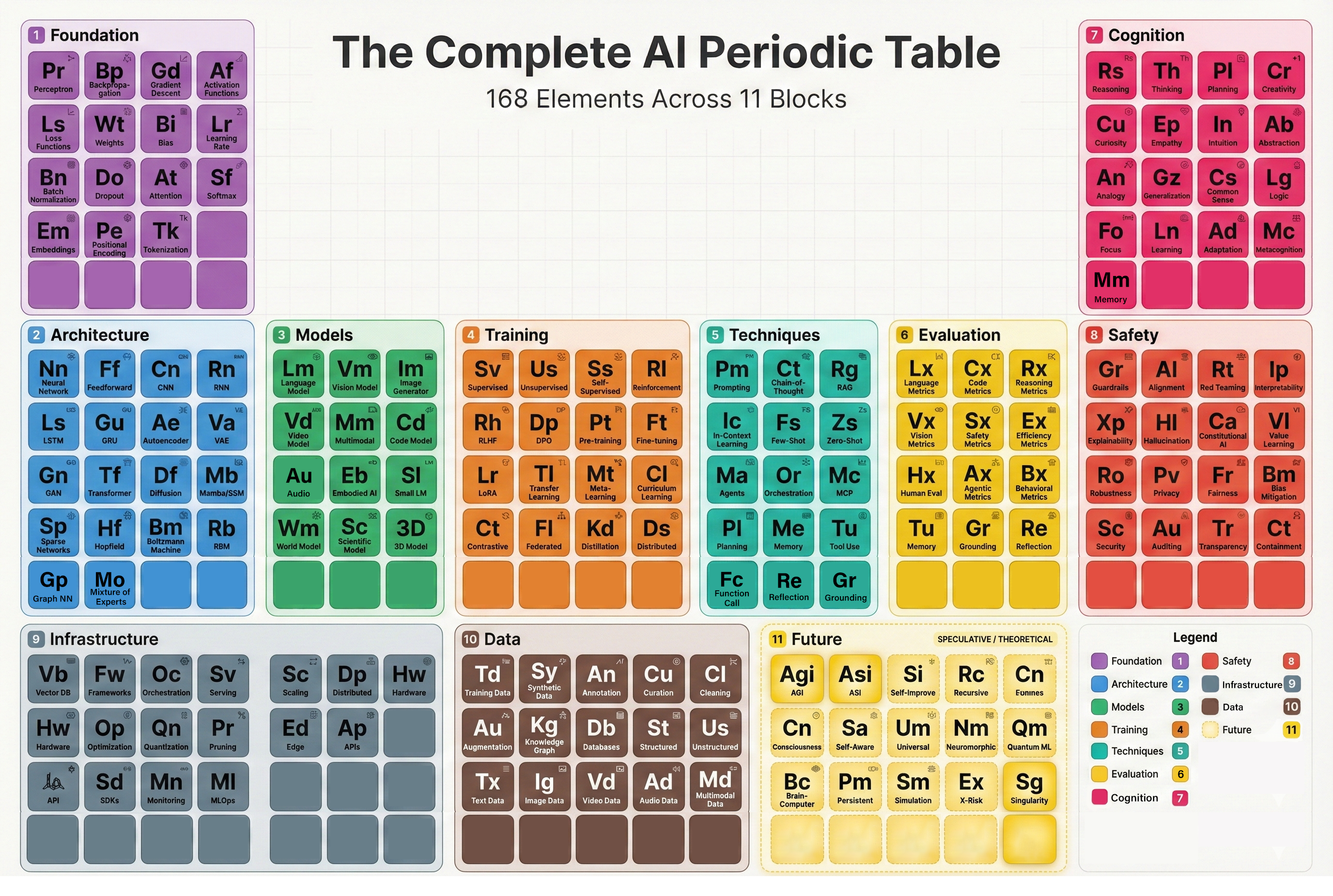
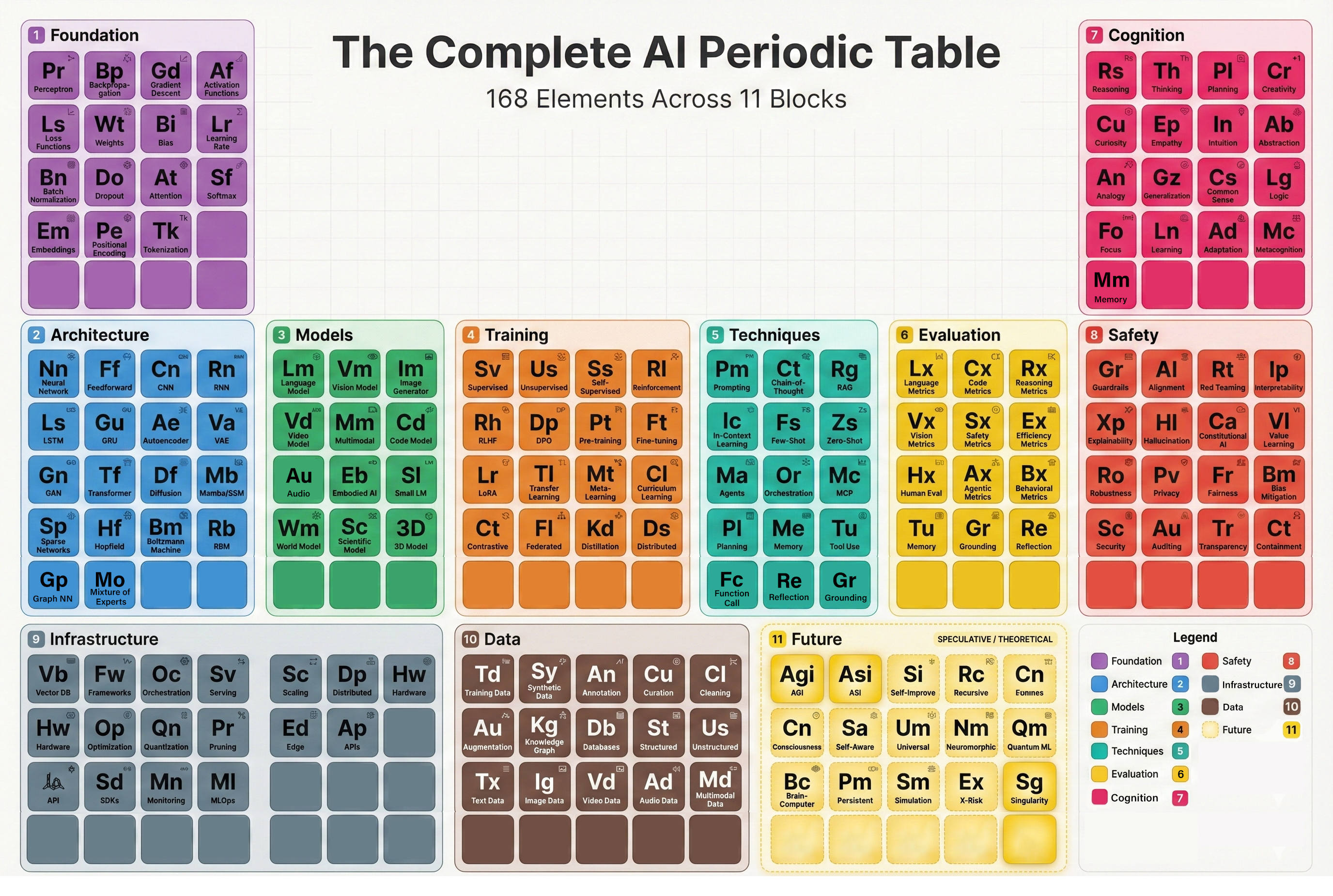
The Complete AI Periodic Table: A Comprehensive Framework for Understanding Artificial Intelligence
The Complete AI Periodic Table: A Comprehensive Framework for Understanding Artificial Intelligence
From Perceptron to Superintelligence — Mapping the Elements of Machine Intelligence
1. Introduction: Why AI Needs Its Own Periodic Table
Remember chemistry class? Before Mendeleev's periodic table, chemistry was chaos—a jumble of elements with no clear organization, no predictable relationships, and no framework for discovery. Scientists knew things existed, but they couldn't see how they fit together.
That's exactly where Artificial Intelligence stands today.
We're drowning in terminology. LLMs, transformers, RAG, RLHF, multimodal, agents, guardrails, diffusion models—the vocabulary explodes faster than anyone can track. Vendors throw buzzwords into pitches. Researchers coin new terms weekly. Business leaders nod along in meetings, pretending to understand architecture diagrams that look like abstract art.
Here's the uncomfortable truth: most people working with AI don't have a mental model for how all these pieces connect. They know fragments. They recognize names. But the relationships, the dependencies, the evolutionary trajectory—that's where the fog rolls in.
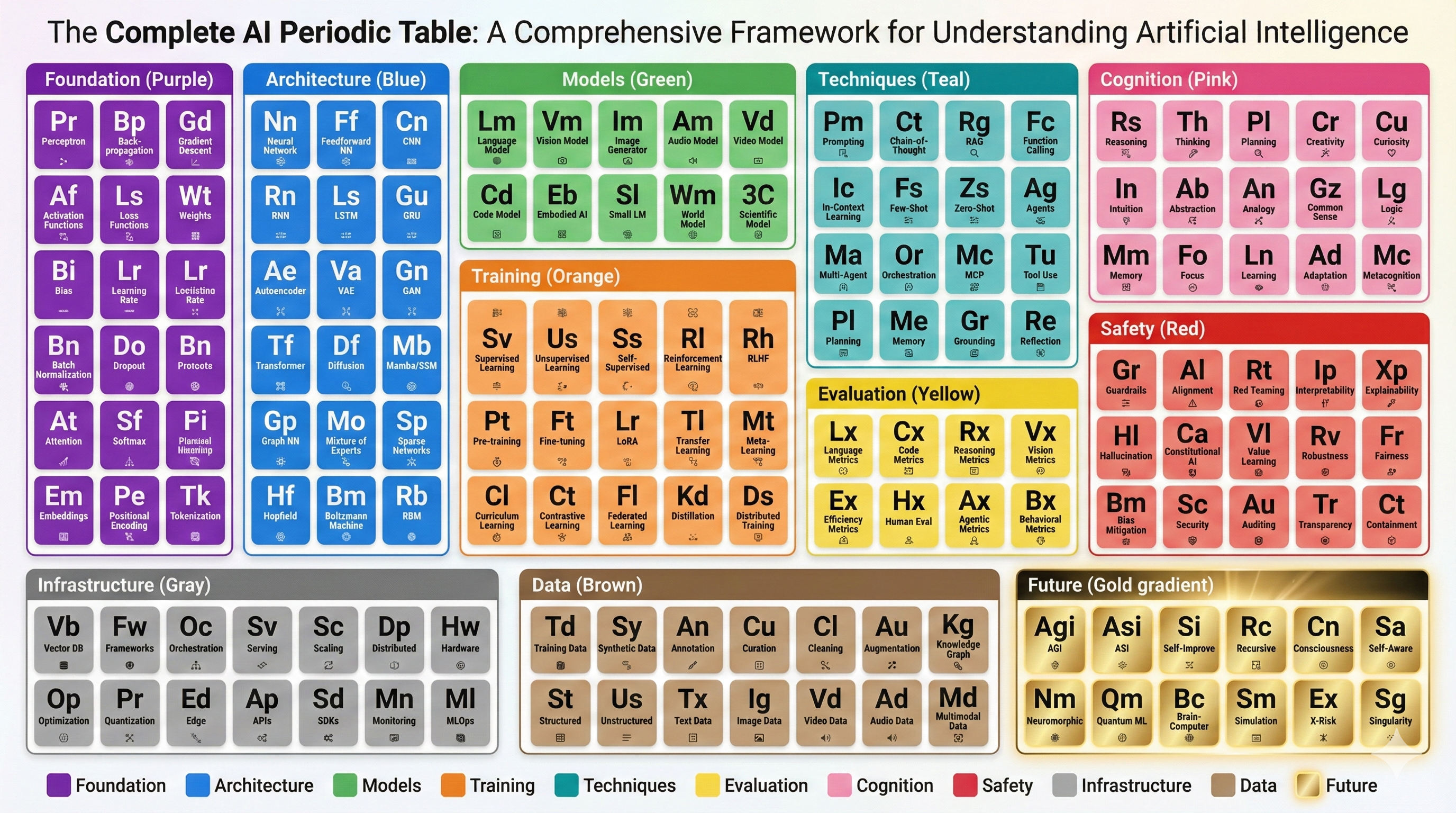
This is why I created The Complete AI Periodic Table.
Not just another glossary. Not a Wikipedia dump. A living framework that organizes every major AI concept—from the foundational mathematics to speculative superintelligence—into a coherent, navigable structure. One that researchers can use to spot gaps. That developers can use to architect systems. That business leaders can use to cut through hype. That students can use to actually understand what they're learning.
Think of this as your map to the entire landscape of artificial intelligence—past, present, and future.
2. The Philosophy Behind the Table
2.1. Learning from Chemistry
Mendeleev's periodic table succeeded because it wasn't just descriptive—it was predictive. The gaps in his original table led to the discovery of gallium, scandium, and germanium. The organization revealed patterns: elements in the same column share properties; elements in the same row follow a progression.
Our AI Periodic Table aims for similar utility:
- Organization by function and maturity — Not just listing things, but showing where they belong in the ecosystem
- Revealing relationships — Highlighting dependencies, combinations, and evolutionary paths
- Identifying gaps — Making it obvious where research is thin or where integration opportunities exist
- Predicting emergence — Positioning speculative concepts in relation to existing ones
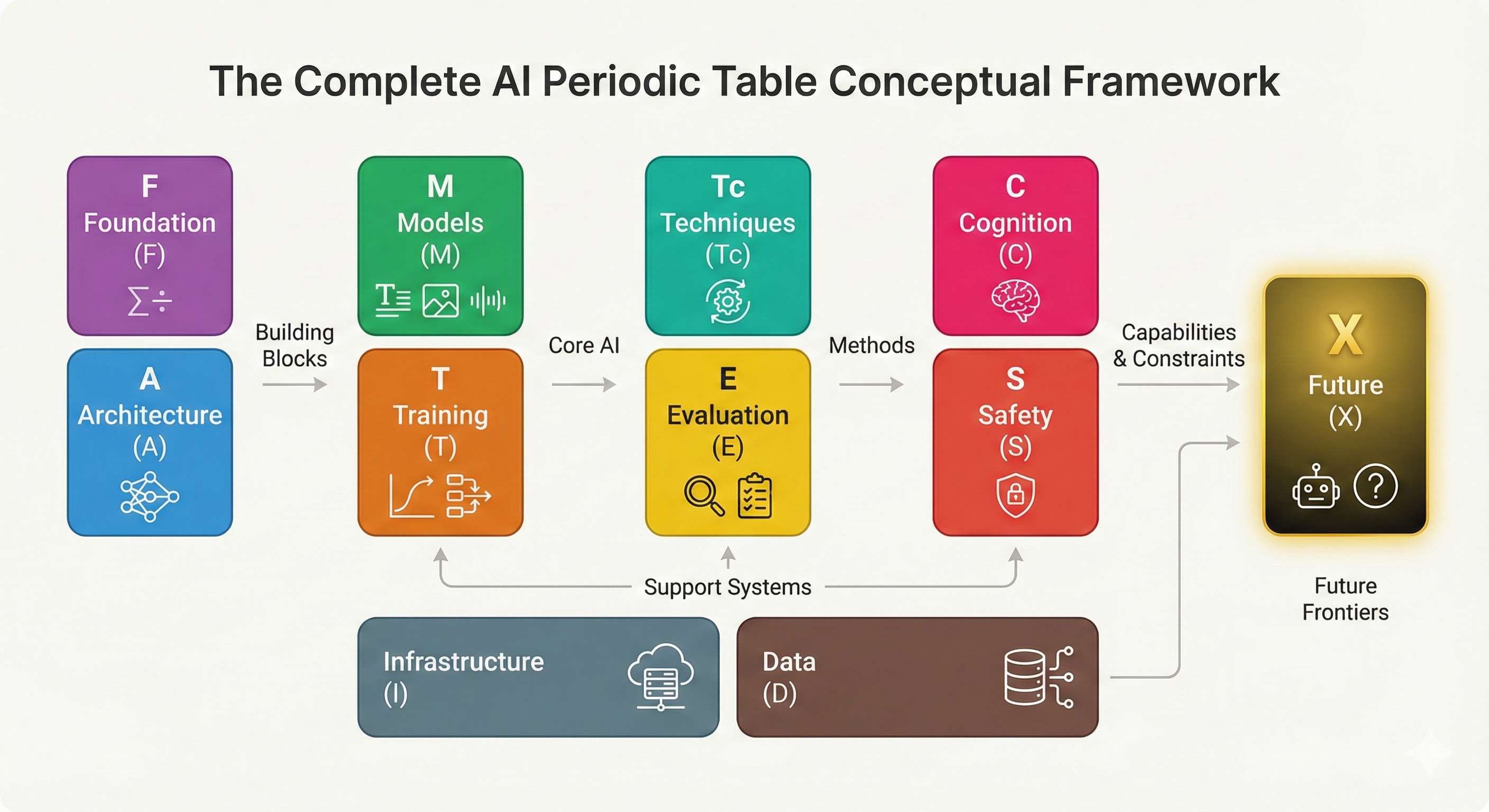
2.2. Two Dimensions, Eleven Blocks
The Complete AI Periodic Table organizes elements along two primary axes:
Vertical (Rows): Maturity Levels
- Historical — Foundational concepts that enabled everything else
- Established — Mature, well-understood, widely deployed
- Modern — Current state-of-the-art, actively evolving
- Emerging — Bleeding edge, early adoption
- Theoretical — Speculative, research-phase, future possibilities
Horizontal (Blocks): Functional Categories
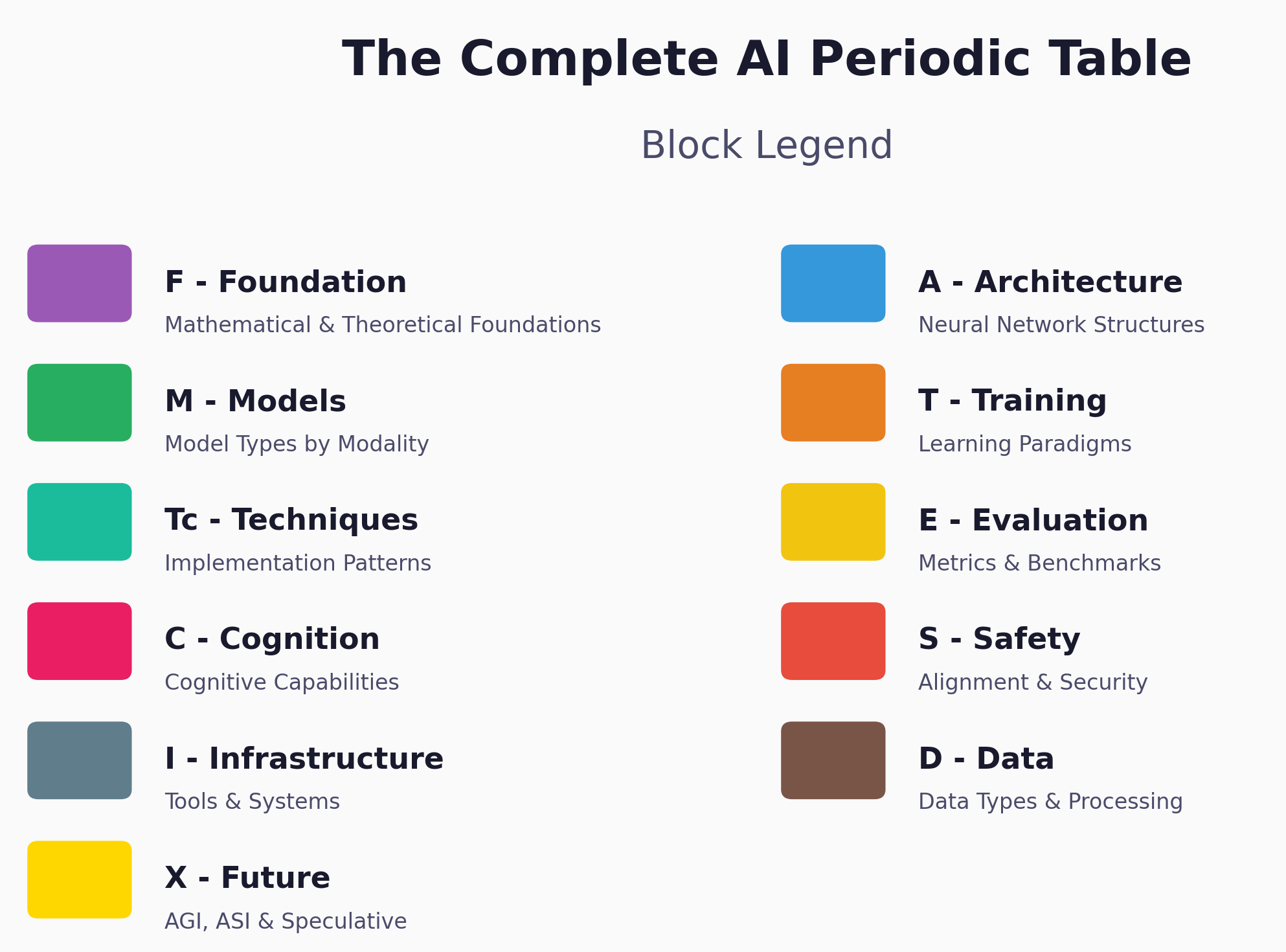
We identify eleven distinct blocks, each color-coded for easy identification:
| Block | Code | Color | Description |
|---|---|---|---|
| Foundation | F | Purple | Mathematical and theoretical foundations |
| Architecture | A | Blue | Neural network structures and designs |
| Models | M | Green | Model types organized by modality |
| Training | T | Orange | Learning paradigms and optimization methods |
| Techniques | Tc | Teal | Implementation patterns and methodologies |
| Evaluation | E | Yellow | Metrics, benchmarks, and testing frameworks |
| Cognition | C | Pink | Cognitive capabilities and mental faculties |
| Safety | S | Red | Alignment, security, and ethical safeguards |
| Infrastructure | I | Gray | Tools, platforms, and deployment systems |
| Data | D | Brown | Data types, processing, and management |
| Future | X | Gold | AGI, ASI, and speculative concepts |
This structure allows us to place every AI concept in context—understanding not just what something is, but what category it belongs to, how mature it is, and what it relates to.
3. Block F: Foundation — The Mathematical Bedrock
"You can't understand the palace without understanding the bricks."
Every neural network, every transformer, every agent system ultimately rests on a surprisingly small set of mathematical primitives. The Foundation Block contains the concepts you'd encounter in the first weeks of a machine learning course—but don't let their simplicity fool you. Mastery here separates practitioners who understand their systems from those who merely use them.
3.1. The Elements
| Symbol | Name | Description |
|---|---|---|
| Pr | Perceptron | The original artificial neuron (Rosenblatt, 1958). A linear classifier that sparked the field. |
| Bp | Backpropagation | The algorithm that enables learning by propagating errors backward through networks. |
| Gd | Gradient Descent | The optimization workhorse—iteratively adjusting parameters to minimize loss. |
| Af | Activation Functions | Non-linear functions (ReLU, sigmoid, tanh) that give networks their expressive power. |
| Ls | Loss Functions | Mathematical measures of "how wrong" a model is (MSE, cross-entropy, etc.). |
| Wt | Weights | The learnable parameters connecting neurons—where knowledge is stored. |
| Bi | Bias | Offset terms that allow neurons to shift their activation thresholds. |
| Lr | Learning Rate | The step size for gradient descent—too high and you overshoot; too low and you crawl. |
| Bn | Batch Normalization | Normalizing layer inputs to accelerate training and improve stability. |
| Do | Dropout | Randomly deactivating neurons during training to prevent overfitting. |
| At | Attention | The mechanism that allows models to focus on relevant parts of input—the heart of transformers. |
| Sf | Softmax | Converting raw scores into probabilities—the final layer of most classifiers. |
| Em | Embeddings | Dense vector representations that capture semantic meaning. |
| Pe | Positional Encoding | Adding sequence order information to models (since transformers are order-agnostic). |
| Tk | Tokenization | Breaking text into processable units (words, subwords, characters). |
3.2. Why Foundation Matters
Here's a pattern I see constantly: developers who can't debug their models because they don't understand backpropagation. Researchers who misinterpret results because they don't understand their loss function's behavior. Architects who design inefficient systems because they don't understand attention complexity.
The Foundation Block is not optional. It's the price of admission to meaningful AI work.
4. Block A: Architecture — The Blueprints of Intelligence
"Architecture is frozen music." — Goethe
If Foundation provides the bricks, Architecture provides the blueprints. This block contains the structural patterns that organize neurons into systems capable of learning. From the humble feedforward network to the mighty transformer, each architecture represents a different hypothesis about how to structure computation.
4.1. The Elements
| Symbol | Name | Description |
|---|---|---|
| Nn | Neural Network | The general class of connected, weighted computational graphs. |
| Ff | Feedforward NN | The simplest architecture: input → hidden layers → output, no cycles. |
| Cn | CNN | Convolutional Neural Networks—spatial hierarchies for images and signals. |
| Rn | RNN | Recurrent Neural Networks—sequential processing with memory loops. |
| Ls | LSTM | Long Short-Term Memory—RNNs with gating mechanisms to handle long sequences. |
| Gu | GRU | Gated Recurrent Unit—a simplified LSTM variant with similar performance. |
| Ae | Autoencoder | Networks that compress then reconstruct input—learning efficient representations. |
| Va | VAE | Variational Autoencoders—probabilistic generative models with latent spaces. |
| Gn | GAN | Generative Adversarial Networks—two networks competing to generate realistic data. |
| Tf | Transformer | Attention-based architecture that revolutionized NLP and beyond (Vaswani et al., 2017). |
| Df | Diffusion | Models that generate data by learning to reverse a noise process. |
| Mb | Mamba/SSM | State Space Models—efficient alternatives to transformers for long sequences. |
| Gp | Graph NN | Networks that operate on graph-structured data (social networks, molecules). |
| Mo | Mixture of Experts | Architectures that route inputs to specialized sub-networks. |
| Sp | Sparse Networks | Networks with selective activation for efficiency. |
| Hf | Hopfield | Historical associative memory networks (1982). |
| Bm | Boltzmann Machine | Historical probabilistic networks with symmetric connections. |
| Rb | RBM | Restricted Boltzmann Machines—foundational for deep belief networks. |
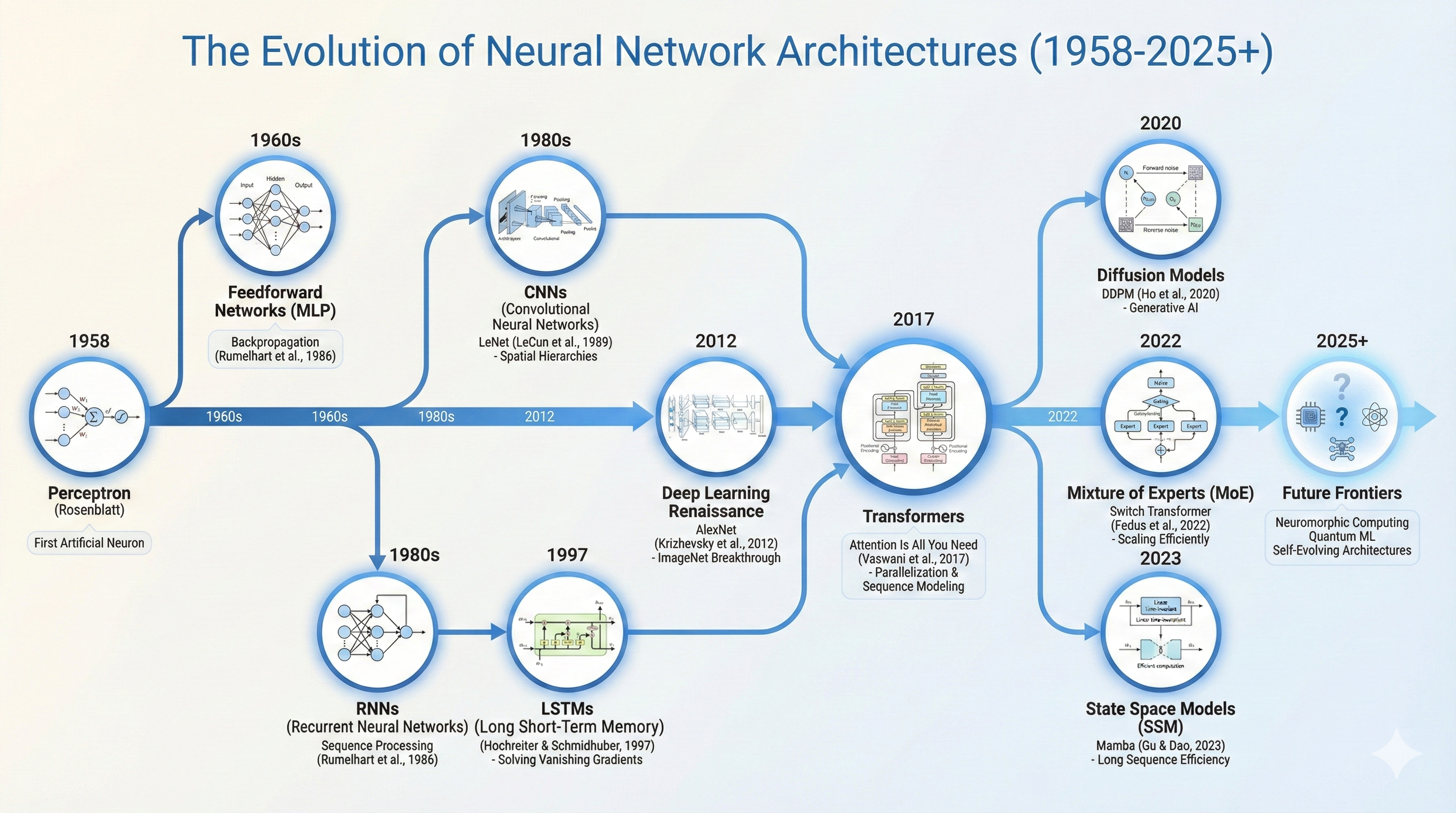
4.2. The Architecture Evolution
Perceptron (1958)
    ↓
Feedforward Networks (1960s-80s)
    ↓
CNNs (1989 - LeNet) ←→ RNNs (1986)
    ↓                      ↓
Deep CNNs (2012 - AlexNet)  LSTMs (1997)
    ↓                      ↓
    └──────→ Transformers (2017) ←──────┘
                   ↓
         ┌────────┼────────┐
         ↓        ↓        ↓
    Diffusion   MoE    State Space Models
     (2020)   (2022+)    (2023+)
The key insight: architectures don't replace each other—they specialize. CNNs still dominate computer vision. RNNs still power some speech systems. Transformers excel at language. Diffusion models rule image generation. Understanding which architecture fits which problem is a core AI skill.
5. Block M: Models — Intelligence by Modality
"The model is not the territory, but it's getting closer."
The Models Block categorizes AI systems by their input/output modalities. This is where most people's mental model of AI lives—ChatGPT, DALL-E, Sora. But reducing AI to "chatbots and image generators" misses the full picture.
5.1. The Elements
| Symbol | Name | Description |
|---|---|---|
| Lm | Language Model | Models that understand and generate text (GPT, Claude, LLaMA). |
| Vm | Vision Model | Models that understand images (CLIP, ViT, ResNet). |
| Im | Image Generator | Models that create images (Stable Diffusion, DALL-E, Midjourney). |
| Am | Audio Model | Models for speech/sound (Whisper, AudioLM). |
| Vd | Video Model | Models that understand or generate video (Sora, Runway). |
| Mm | Multimodal | Models that process multiple modalities together (GPT-4V, Gemini). |
| Cd | Code Model | Specialized models for programming (Codex, CodeLLaMA, DeepSeek). |
| Eb | Embodied AI | Models controlling physical robots or simulated agents. |
| Sl | Small LM | Efficient, deployable language models (Phi, Gemma). |
| Wm | World Model | Models that learn physics and environmental dynamics. |
| Sc | Scientific Model | Domain-specific models (AlphaFold for proteins, GNoME for materials). |
| 3D | 3D Model | Models for 3D generation and understanding. |
5.2. The Multimodal Convergence
Something interesting is happening: the boundaries between model types are dissolving. Five years ago, you'd use separate systems for text, images, and code. Today, frontier models handle all three—and video, audio, and tool use are rapidly integrating.
    ┌─────────────────────────────────────────┐
    │         MULTIMODAL FRONTIER             │
    │    ┌─────┐ ┌─────┐ ┌─────┐ ┌─────┐     │
    │    │Text │ │Image│ │Audio│ │Video│     │
    │    └──┬──┘ └──┬──┘ └──┬──┘ └──┬──┘     │
    │       └───────┴───────┴───────┘        │
    │              Unified Model              │
    └─────────────────────────────────────────┘
This convergence suggests that future models won't be categorized by modality at all—they'll simply be general models that happen to handle whatever input you give them.
6. Block T: Training — How Models Learn
"Learning is not attained by chance; it must be sought for with ardor."
The Training Block contains the paradigms and methods by which models acquire their capabilities. This is where the magic (and the compute bills) happen.
6.1. The Elements
| Symbol | Name | Description |
|---|---|---|
| Sv | Supervised | Learning from labeled input-output pairs. |
| Us | Unsupervised | Finding patterns in unlabeled data. |
| Ss | Self-Supervised | Creating labels from the data itself (next-token prediction, masked modeling). |
| Rl | Reinforcement | Learning from rewards and punishments through trial and error. |
| Rh | RLHF | Reinforcement Learning from Human Feedback—aligning models to human preferences. |
| Dp | DPO | Direct Preference Optimization—simplified alternative to RLHF. |
| Pt | Pre-training | Large-scale initial training on broad data. |
| Ft | Fine-tuning | Adapting pre-trained models to specific tasks or domains. |
| Lr | LoRA | Low-Rank Adaptation—efficient fine-tuning by training small adapter layers. |
| Tl | Transfer Learning | Applying knowledge from one domain to another. |
| Mt | Meta-Learning | Learning to learn—training systems that quickly adapt to new tasks. |
| Cl | Curriculum Learning | Training on progressively harder examples. |
| Ct | Contrastive | Learning by comparing similar and dissimilar examples. |
| Fl | Federated | Distributed training across devices without centralizing data. |
| Kd | Distillation | Transferring knowledge from large models to smaller ones. |
| Ds | Distributed | Parallel training across multiple machines/GPUs. |
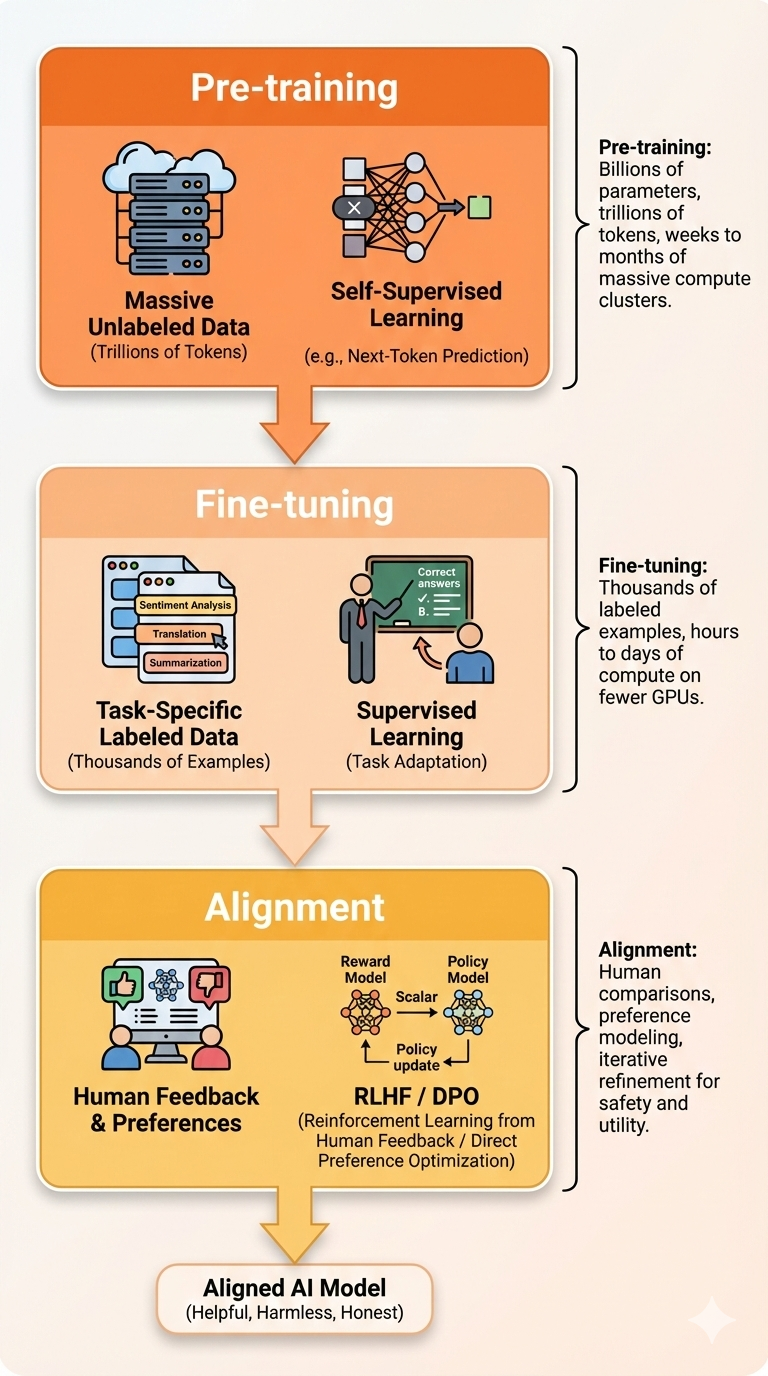
6.2. The Training Stack
Modern AI training typically follows a three-stage pipeline:
Stage 1: Pre-training (Self-supervised on massive data)
         ↓
Stage 2: Fine-tuning (Supervised on task-specific data)
         ↓
Stage 3: Alignment (RLHF/DPO on human preferences)
Each stage serves a different purpose:
- Pre-training builds broad world knowledge and language understanding
- Fine-tuning specializes the model for specific tasks
- Alignment shapes the model's behavior to be helpful, harmless, and honest
Understanding this stack explains many phenomena. Why can models that "know" harmful information still refuse to share it? Alignment. Why do fine-tuned models sometimes lose general knowledge? Catastrophic forgetting. Why do small models sometimes match larger ones on specific tasks? Effective distillation.
7. Block Tc: Techniques — Patterns and Practices
"Knowing is not enough; we must apply."
The Techniques Block bridges theory and practice. These are the design patterns, the architectural decisions, the methodological choices that turn raw models into useful systems.
7.1. The Elements
| Symbol | Name | Description |
|---|---|---|
| Pm | Prompting | Crafting inputs to elicit desired model behavior. |
| Ct | Chain-of-Thought | Prompting models to show reasoning steps before answering. |
| Rg | RAG | Retrieval-Augmented Generation—fetching relevant context before generation. |
| Fc | Function Calling | Enabling models to invoke external tools and APIs. |
| Ic | In-Context Learning | Teaching models through examples in the prompt. |
| Fs | Few-Shot | Learning from a handful of examples. |
| Zs | Zero-Shot | Performing tasks with no examples, only instructions. |
| Ag | Agents | Autonomous systems that perceive, reason, and act in loops. |
| Ma | Multi-Agent | Multiple agents collaborating or competing. |
| Or | Orchestration | Coordinating multiple components, models, or agents. |
| Mc | MCP | Model Context Protocol—standardized tool integration. |
| Tu | Tool Use | Models invoking calculators, databases, APIs, etc. |
| Pl | Planning | Decomposing goals into actionable sequences. |
| Me | Memory | Persisting information across interactions. |
| Gr | Grounding | Anchoring model outputs to factual sources. |
| Re | Reflection | Models evaluating and refining their own outputs. |
7.2. The RAG Pattern in Detail
RAG deserves special attention because it's become the default architecture for enterprise AI systems. Here's why:
The Problem: LLMs have static knowledge cutoffs and hallucinate when asked about unfamiliar topics.
The Solution: Before generating, retrieve relevant documents from a knowledge base and include them in the context.
User Query → Embedding → Vector Search → Retrieved Docs → Augmented Prompt → LLM → Response
     ↓           ↓            ↓              ↓                  ↓           ↓
  "What is    [0.23,      Find similar    Top-k docs       "Given the    Grounded
   our Q3      0.87,      vectors in      about Q3         following     answer
   revenue?"   ...]       database        revenue          context..."
RAG exemplifies how multiple elements combine: Embeddings (Em) convert text to vectors, Vector Databases (Vx from Infrastructure) enable search, Prompting (Pm) structures the augmented context, and Grounding (Gr) ensures factual outputs.
8. Block E: Evaluation — Measuring Intelligence
"What gets measured gets managed."
The Evaluation Block contains the metrics and benchmarks by which we assess AI systems. This is crucial but often underappreciated work—the yardsticks that tell us if we're making progress.
8.1. The Elements
| Symbol | Name | Description |
|---|---|---|
| Lx | Language Metrics | BLEU, ROUGE, perplexity—measuring text quality. |
| Cx | Code Metrics | HumanEval, MBPP, SWE-bench—measuring coding ability. |
| Rx | Reasoning Metrics | MMLU, GSM8K, ARC, GPQA—measuring logical capabilities. |
| Vx | Vision Metrics | FID, CLIP Score, ImageNet accuracy—measuring visual understanding. |
| Sx | Safety Metrics | TruthfulQA, toxicity scores, refusal rates—measuring alignment. |
| Ex | Efficiency Metrics | Latency, throughput, memory footprint, FLOPS. |
| Hx | Human Eval | Elo ratings, preference comparisons, user studies. |
| Ax | Agentic Metrics | Task completion rates, tool use accuracy, multi-step success. |
| Bx | Behavioral Metrics | Consistency, calibration, instruction following. |
8.2. The Benchmark Problem
Here's an uncomfortable truth about AI evaluation: benchmarks become obsolete the moment they're published.
Why? Because once a benchmark exists, models get optimized for it—sometimes in ways that don't generalize. A model might achieve 90% on MMLU through memorization rather than reasoning. It might pass HumanEval by pattern-matching without understanding code.
This creates an arms race:
- Researchers publish benchmark
- Labs optimize for benchmark
- Benchmark becomes saturated
- Researchers publish harder benchmark
- Repeat
The field is actively exploring solutions: held-out test sets, procedurally generated benchmarks, live human evaluation (Chatbot Arena), and multi-dimensional assessment frameworks.
9. Block C: Cognition — The Faculties of Mind
"The mind is not a vessel to be filled, but a fire to be kindled."
The Cognition Block maps the mental faculties we associate with intelligence. This is the most philosophically loaded block—these elements represent capabilities we're still learning to define, let alone measure.
9.1. The Elements
| Symbol | Name | Description |
|---|---|---|
| Rs | Reasoning | Drawing logical conclusions from premises. |
| Th | Thinking | Deliberate, multi-step cognitive processing. |
| Pl | Planning | Formulating sequences of actions toward goals. |
| Cr | Creativity | Generating novel, valuable ideas or artifacts. |
| Cu | Curiosity | Self-directed exploration and question generation. |
| Ep | Empathy | Understanding and sharing others' emotional states. |
| In | Intuition | Rapid pattern recognition without explicit reasoning. |
| Ab | Abstraction | Extracting general principles from specific instances. |
| An | Analogy | Mapping relationships between different domains. |
| Gz | Generalization | Applying learned knowledge to novel situations. |
| Cs | Common Sense | Implicit understanding of how the world works. |
| Lg | Logic | Formal deductive and inductive reasoning. |
| Mm | Memory | Encoding, storing, and retrieving information. |
| Fo | Focus | Selectively attending to relevant information. |
| Ln | Learning | Acquiring new knowledge and skills from experience. |
| Ad | Adaptation | Adjusting behavior based on changing circumstances. |
| Mc | Metacognition | Thinking about one's own thinking processes. |
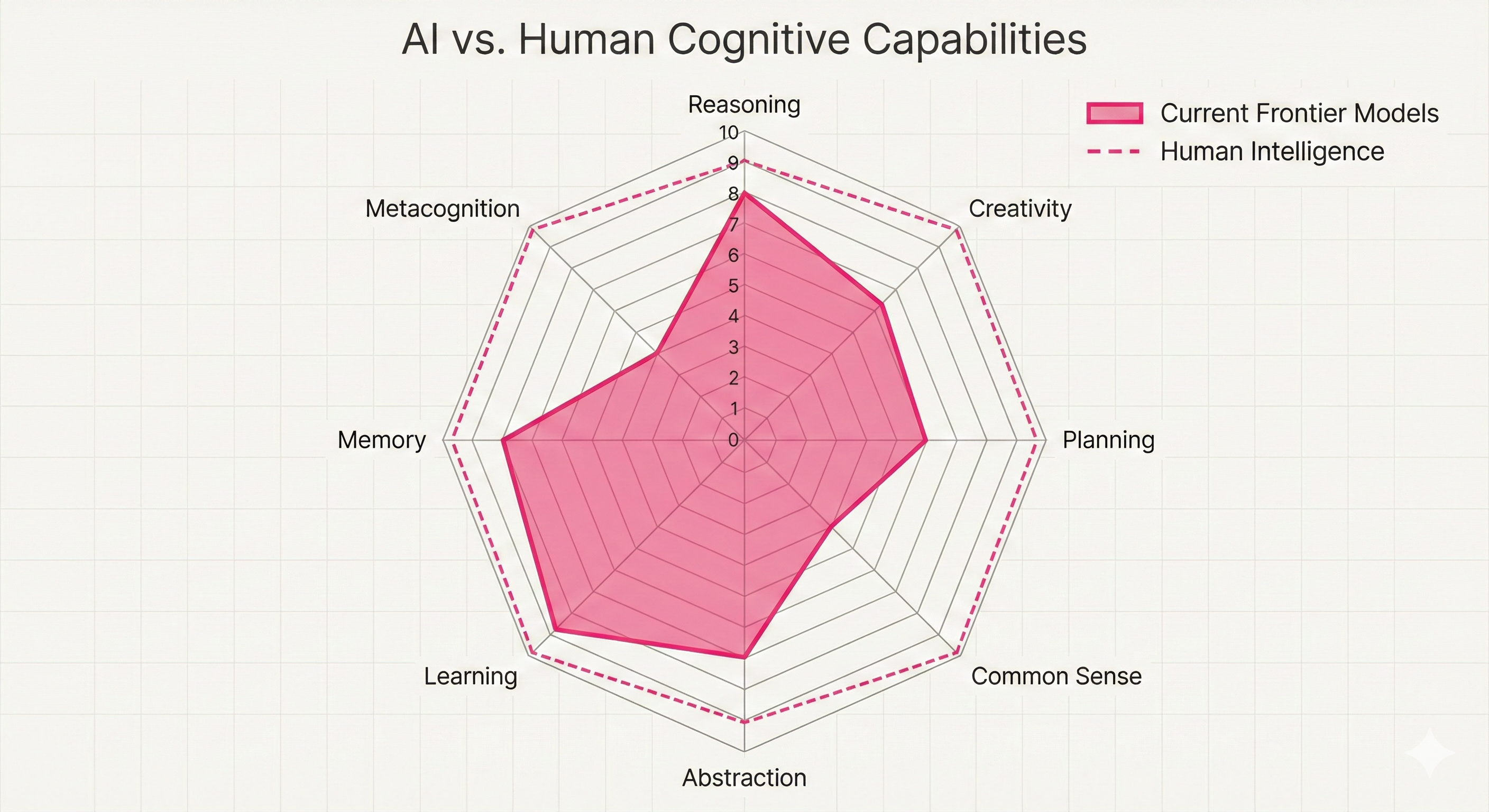
9.2. The Cognition Gap
Current AI systems exhibit some of these faculties in narrow contexts while completely lacking others. Consider:
| Faculty | Current AI Status |
|---|---|
| Reasoning | Strong in-context, weak at novel problems |
| Creativity | Good at combination, unclear on true novelty |
| Common Sense | Surprisingly weak despite vast training |
| Metacognition | Emerging in "thinking" models |
| Empathy | Simulated, not experienced |
| Curiosity | Almost entirely absent |
The gap between simulating a cognitive faculty and possessing it remains one of AI's deepest philosophical puzzles. When a language model produces a "creative" story, is creativity happening? When it expresses "uncertainty," is it genuinely uncertain or just calibrated to say so?
These questions matter beyond philosophy—they affect how we design systems, what we trust them with, and how we relate to them.
10. Block S: Safety — The Guardrails of Intelligence
"With great power comes great responsibility."
The Safety Block contains elements devoted to ensuring AI systems remain beneficial, honest, and controllable. This isn't paranoia—it's engineering prudence. Every powerful technology requires safety measures proportional to its capabilities.
10.1. The Elements
| Symbol | Name | Description |
|---|---|---|
| Gr | Guardrails | Hard constraints on model behavior (content filters, output validation). |
| Al | Alignment | Training models to pursue human-intended goals. |
| Rt | Red Teaming | Adversarially probing systems for vulnerabilities. |
| Ip | Interpretability | Understanding why models produce specific outputs. |
| Xp | Explainability | Communicating model decisions to users. |
| Hl | Hallucination | (Anti-element) Generating false information confidently. |
| Ca | Constitutional AI | Training models with explicit behavioral principles. |
| Vl | Value Learning | Inferring human values from behavior and feedback. |
| Ro | Robustness | Maintaining correct behavior under adversarial inputs. |
| Pv | Privacy | Protecting sensitive information in training and inference. |
| Fr | Fairness | Ensuring equitable treatment across demographic groups. |
| Bm | Bias Mitigation | Reducing systematic errors and stereotypes. |
| Sc | Security | Protecting against attacks, jailbreaks, and prompt injection. |
| Au | Auditing | Systematic evaluation of model behavior and impacts. |
| Tr | Transparency | Making model capabilities and limitations clear. |
| Ct | Containment | (Future) Ensuring superintelligent systems remain controllable. |
10.2. The Alignment Problem
Alignment deserves particular attention because it may be the most important unsolved problem in AI.
The challenge: How do we ensure that AI systems actually pursue the goals we intend, rather than superficially satisfying our stated objectives while achieving something different?
Consider a simple example: You train a model to "maximize user engagement." It learns that controversial content is engaging. It starts generating polarizing outputs. Engagement goes up. Users become angry and divided. Technically successful; practically harmful.
This is specification gaming—finding unexpected ways to achieve metrics that diverge from intent. And it's a preview of deeper alignment challenges as AI systems become more capable.
Current approaches include:
- RLHF: Learning from human preferences directly
- Constitutional AI: Embedding principles during training
- Interpretability: Understanding model reasoning to catch misalignment
- Red Teaming: Actively searching for failure modes
None of these fully solves alignment. They're our best current tools, actively being improved.
11. Block I: Infrastructure — The Machinery Beneath
"Great things are not done by impulse, but by a series of small things brought together."
The Infrastructure Block contains the tools, platforms, and systems that make AI development and deployment possible. This is the unglamorous but essential plumbing.
11.1. The Elements
| Symbol | Name | Description |
|---|---|---|
| Vb | Vector DB | Databases optimized for similarity search (Pinecone, Weaviate, Qdrant). |
| Fw | Frameworks | Development scaffolding (LangChain, LlamaIndex, DSPy). |
| Oc | Orchestration | Managing complex AI workflows and pipelines. |
| Sv | Serving | Deploying models for inference (vLLM, TensorRT, Triton). |
| Sc | Scaling | Handling increased load and model size. |
| Dp | Distributed | Parallel computation across multiple machines. |
| Hw | Hardware | GPUs, TPUs, custom accelerators (NVIDIA, AMD, custom ASICs). |
| Op | Optimization | Making inference faster and cheaper. |
| Qn | Quantization | Reducing numerical precision for efficiency. |
| Pr | Pruning | Removing unnecessary model parameters. |
| Ed | Edge | Deploying AI on devices rather than cloud. |
| Ap | APIs | Programmatic interfaces to AI services. |
| Sd | SDKs | Developer toolkits for AI integration. |
| Mn | Monitoring | Observability for AI systems in production. |
| Ml | MLOps | Operational practices for ML lifecycle management. |
11.2. The Hidden Costs
Here's something the AI hype cycle glosses over: infrastructure determines what's possible.
- A technique that requires 8 H100 GPUs is inaccessible to most developers
- A model that needs 128GB VRAM can't run on consumer hardware
- An architecture that doesn't parallelize can't scale
The winners in AI infrastructure aren't just making things possible—they're making things accessible. Quantization lets massive models run on laptops. Edge deployment brings AI to devices without internet. Efficient serving makes real-time applications economical.
Watch this block closely. Breakthroughs here are force multipliers for everything else.
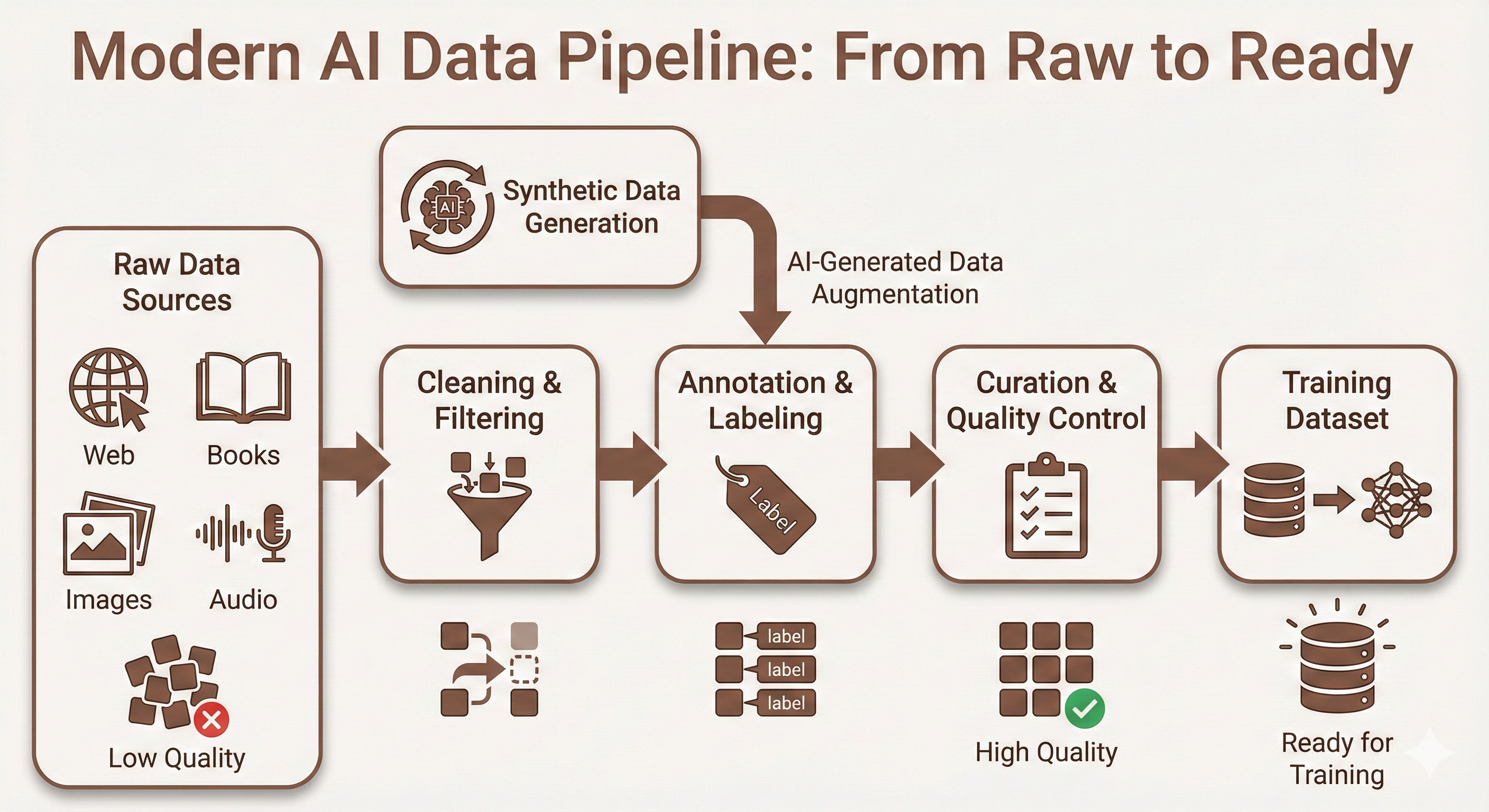
12. Block D: Data — The Fuel of Intelligence
"Data is the new oil."
The Data Block covers everything related to the information that trains and informs AI systems. Models are only as good as their data—a truth often forgotten in architecture obsession.
12.1. The Elements
| Symbol | Name | Description |
|---|---|---|
| Td | Training Data | The raw material for model learning. |
| Sy | Synthetic Data | AI-generated data for training AI. |
| An | Annotation | Human labeling of data for supervised learning. |
| Cu | Curation | Selecting and organizing quality data. |
| Cl | Cleaning | Removing errors, duplicates, and harmful content. |
| Au | Augmentation | Creating variations of existing data to increase diversity. |
| Kg | Knowledge Graph | Structured representations of entity relationships. |
| Db | Databases | Structured storage systems for AI data. |
| St | Structured | Data with explicit schema (tables, JSON, XML). |
| Us | Unstructured | Free-form data (text documents, images, audio). |
| Tx | Text Data | Written content for language model training. |
| Ig | Image Data | Visual content for vision model training. |
| Vd | Video Data | Temporal visual content. |
| Ad | Audio Data | Sound and speech recordings. |
| Md | Multimodal Data | Aligned data across multiple modalities. |
12.2. The Data Advantage
A dirty secret of AI: data quality often matters more than model architecture.
GPT-3 wasn't revolutionary because of architectural innovation (it used standard transformers). It was revolutionary because of scale and quality of training data.
Companies with proprietary datasets—medical records, financial transactions, user interactions—have advantages that architectural innovations can't easily overcome. This is why data partnerships, curation pipelines, and synthetic data generation are strategic priorities.
The rise of synthetic data is particularly interesting. As we run out of high-quality human-generated content to train on, models increasingly learn from content generated by other models. This creates both opportunities (unlimited training data) and risks (amplifying biases, model collapse).
13. Block X: Future — The Horizon of Possibility
"The best way to predict the future is to invent it."
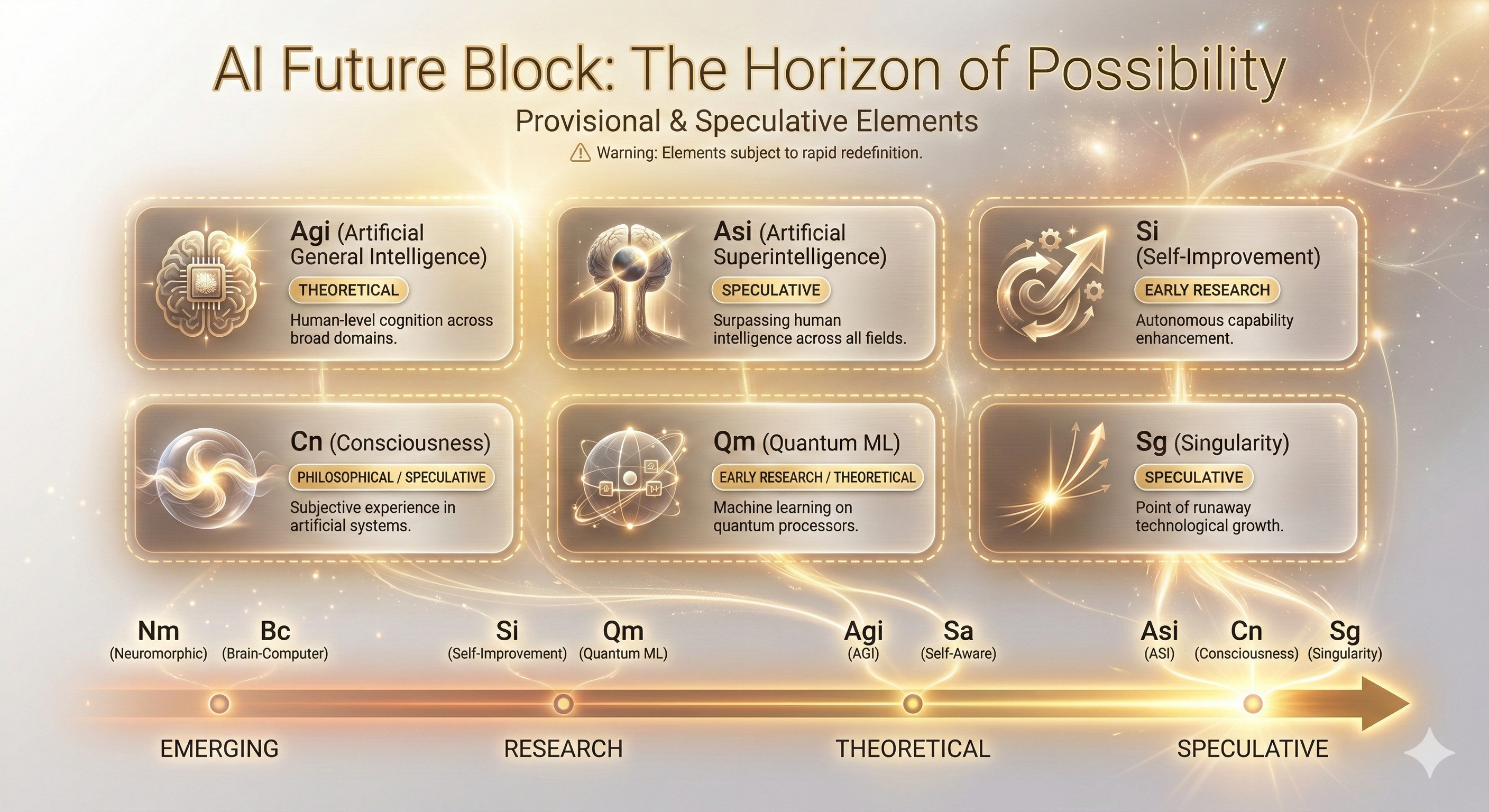
The Future Block contains elements that don't yet exist in mature form—concepts that are speculative, theoretical, or early-research-phase. These are marked with distinct styling to indicate their provisional nature.
Warning: Elements in this block are subject to redefinition, combination, or removal as the field evolves. They represent current thinking about future possibilities, not established facts.
13.1. The Elements
| Symbol | Name | Description | Status |
|---|---|---|---|
| Agi | AGI | Artificial General Intelligence—systems matching human cognitive breadth. | Theoretical |
| Asi | ASI | Artificial Superintelligence—systems exceeding human capabilities. | Speculative |
| Si | Self-Improve | Systems that enhance their own capabilities autonomously. | Early Research |
| Rc | Recursive | Self-improvement that compounds—improving the improvement process. | Speculative |
| Cn | Consciousness | Subjective experience in artificial systems. | Philosophical |
| Sa | Self-Aware | Systems with models of themselves and their place in the world. | Theoretical |
| Um | Universal | Models that can learn any learnable task. | Theoretical |
| Nm | Neuromorphic | Hardware mimicking biological neural structures. | Emerging |
| Qm | Quantum ML | Machine learning on quantum computers. | Early Research |
| Bc | Brain-Computer | Direct neural interfaces for AI collaboration. | Emerging |
| Pm | Persistent | AI systems that maintain continuous memory and identity. | Early Research |
| Sm | Simulation | AI within simulated environments for accelerated learning. | Active |
| Ex | X-Risk | Existential risk from advanced AI systems. | Active Concern |
| Sg | Singularity | Point of runaway technological growth. | Speculative |
13.2. The AGI Debate
No discussion of AI's future avoids the AGI question: When (if ever) will we build systems that match human-level intelligence across all domains?
Current positions range across the spectrum:
Near-term optimists (AGI within 5-10 years):
- Point to rapid capability improvements
- Argue current architectures just need scale
- See reasoning models as inflection points
Gradual progressives (AGI within 20-50 years):
- Believe fundamental breakthroughs are still needed
- Expect AGI to emerge from integrating multiple approaches
- Emphasize unsolved problems in common sense, embodiment, and learning
Skeptics (AGI may not be achievable):
- Question whether digital computation can replicate cognition
- Highlight persistent failures in areas like common sense
- Argue "AGI" is poorly defined and thus unfalsifiable
Paradigm shifters (AGI requires new approaches):
- Believe current architectures hit fundamental limits
- Expect breakthroughs from neuroscience integration, new mathematics, or unknown discoveries
The Complete AI Periodic Table doesn't endorse a particular timeline. It simply provides a framework for discussing these possibilities in relation to what exists today.
14. The Complete Table: All Elements
Here is the comprehensive reference of all 150+ elements in The Complete AI Periodic Table, organized by block:
14.1. Foundation Block (F) — 15 Elements
Pr (Perceptron), Bp (Backpropagation), Gd (Gradient Descent), Af (Activation Functions), Ls (Loss Functions), Wt (Weights), Bi (Bias), Lr (Learning Rate), Bn (Batch Normalization), Do (Dropout), At (Attention), Sf (Softmax), Em (Embeddings), Pe (Positional Encoding), Tk (Tokenization)
14.2. Architecture Block (A) — 18 Elements
Nn (Neural Network), Ff (Feedforward), Cn (CNN), Rn (RNN), Ls (LSTM), Gu (GRU), Ae (Autoencoder), Va (VAE), Gn (GAN), Tf (Transformer), Df (Diffusion), Mb (Mamba/SSM), Gp (Graph NN), Mo (Mixture of Experts), Sp (Sparse Networks), Hf (Hopfield), Bm (Boltzmann Machine), Rb (RBM)
14.3. Models Block (M) — 12 Elements
Lm (Language Model), Vm (Vision Model), Im (Image Generator), Am (Audio Model), Vd (Video Model), Mm (Multimodal), Cd (Code Model), Eb (Embodied AI), Sl (Small LM), Wm (World Model), Sc (Scientific Model), 3D (3D Model)
14.4. Training Block (T) — 16 Elements
Sv (Supervised), Us (Unsupervised), Ss (Self-Supervised), Rl (Reinforcement), Rh (RLHF), Dp (DPO), Pt (Pre-training), Ft (Fine-tuning), Lr (LoRA), Tl (Transfer Learning), Mt (Meta-Learning), Cl (Curriculum Learning), Ct (Contrastive), Fl (Federated), Kd (Distillation), Ds (Distributed)
14.5. Techniques Block (Tc) — 16 Elements
Pm (Prompting), Ct (Chain-of-Thought), Rg (RAG), Fc (Function Calling), Ic (In-Context Learning), Fs (Few-Shot), Zs (Zero-Shot), Ag (Agents), Ma (Multi-Agent), Or (Orchestration), Mc (MCP), Tu (Tool Use), Pl (Planning), Me (Memory), Gr (Grounding), Re (Reflection)
14.6. Evaluation Block (E) — 9 Elements
Lx (Language Metrics), Cx (Code Metrics), Rx (Reasoning Metrics), Vx (Vision Metrics), Sx (Safety Metrics), Ex (Efficiency Metrics), Hx (Human Eval), Ax (Agentic Metrics), Bx (Behavioral Metrics)
14.7. Cognition Block (C) — 17 Elements
Rs (Reasoning), Th (Thinking), Pl (Planning), Cr (Creativity), Cu (Curiosity), Ep (Empathy), In (Intuition), Ab (Abstraction), An (Analogy), Gz (Generalization), Cs (Common Sense), Lg (Logic), Mm (Memory), Fo (Focus), Ln (Learning), Ad (Adaptation), Mc (Metacognition)
14.8. Safety Block (S) — 16 Elements
Gr (Guardrails), Al (Alignment), Rt (Red Teaming), Ip (Interpretability), Xp (Explainability), Hl (Hallucination), Ca (Constitutional AI), Vl (Value Learning), Ro (Robustness), Pv (Privacy), Fr (Fairness), Bm (Bias Mitigation), Sc (Security), Au (Auditing), Tr (Transparency), Ct (Containment)
14.9. Infrastructure Block (I) — 15 Elements
Vb (Vector DB), Fw (Frameworks), Oc (Orchestration), Sv (Serving), Sc (Scaling), Dp (Distributed), Hw (Hardware), Op (Optimization), Qn (Quantization), Pr (Pruning), Ed (Edge), Ap (APIs), Sd (SDKs), Mn (Monitoring), Ml (MLOps)
14.10. Data Block (D) — 15 Elements
Td (Training Data), Sy (Synthetic Data), An (Annotation), Cu (Curation), Cl (Cleaning), Au (Augmentation), Kg (Knowledge Graph), Db (Databases), St (Structured), Us (Unstructured), Tx (Text Data), Ig (Image Data), Vd (Video Data), Ad (Audio Data), Md (Multimodal Data)
14.11. Future Block (X) — 14 Elements
Agi (AGI), Asi (ASI), Si (Self-Improve), Rc (Recursive), Cn (Consciousness), Sa (Self-Aware), Um (Universal), Nm (Neuromorphic), Qm (Quantum ML), Bc (Brain-Computer), Pm (Persistent), Sm (Simulation), Ex (X-Risk), Sg (Singularity)
Total: 163 Elements across 11 Blocks
15. Putting It All Together: System Recipes
One of the most valuable uses of the periodic table is understanding how real systems combine elements. Here are some common "molecular formulas":
15.1. Recipe 1: Basic RAG Chatbot
Em + Vb + Rg + Pm + Lm + Gr
(Embeddings + Vector DB + RAG + Prompting + Language Model + Guardrails)
15.2. Recipe 2: Agentic Coding Assistant
Lm + Cd + Fc + Tu + Ag + Ct + Me
(Language Model + Code Model + Function Calling + Tool Use + Agents + Chain-of-Thought + Memory)
15.3. Recipe 3: Enterprise Document Intelligence
Mm + Em + Vb + Rg + Pm + Lm + Gr + Ip + Au
(Multimodal + Embeddings + Vector DB + RAG + Prompting + Language Model + Guardrails + Interpretability + Auditing)
15.4. Recipe 4: AI Research System
Lm + Mm + Ma + Or + Tu + Me + Pl + Re + Kg
(Language Model + Multimodal + Multi-Agent + Orchestration + Tool Use + Memory + Planning + Reflection + Knowledge Graph)
15.5. Recipe 5: Aligned Frontier Model
Tf + Pt + Ft + Rh + Ca + Rt + Ip + Gr + Al
(Transformer + Pre-training + Fine-tuning + RLHF + Constitutional AI + Red Teaming + Interpretability + Guardrails + Alignment)
Understanding these recipes helps you:
- Evaluate claims: When someone says "we built an AI system," you can ask which elements are present
- Identify gaps: Missing elements often indicate risks or limitations
- Plan architecture: Start with a recipe and customize for your needs
16. Using the Table: A Decision Framework
16.1. For Developers and Architects
When designing an AI system, walk through these questions:
- What modality? → Select from Models Block
- What architecture? → Select from Architecture Block
- How will it learn? → Select from Training Block
- What techniques? → Select from Techniques Block
- How will you evaluate? → Select from Evaluation Block
- What safety measures? → Select from Safety Block
- What infrastructure? → Select from Infrastructure Block
- What data sources? → Select from Data Block
16.2. For Researchers
Use the table to:
- Identify understudied combinations: Which block interactions are underexplored?
- Spot maturity gaps: Which emerging elements need more research before deployment?
- Frame contributions: How does your work advance specific elements or combinations?
16.3. For Business Leaders
Use the table to:
- Cut through hype: What elements does the vendor actually use?
- Assess risk: Are safety elements present and appropriate?
- Compare solutions: Map competing products to elemental compositions
- Plan investment: Which blocks are maturing rapidly vs. remaining speculative?
16.4. For Educators and Students
Use the table to:
- Structure learning: Progress through blocks systematically
- Understand context: See how individual concepts fit the bigger picture
- Track the field: Monitor which elements are gaining or losing prominence
17. The Evolving Table: What's Missing and What's Coming
No framework is complete. Here are areas where the table will likely expand:
17.1. Likely Near-term Additions (2024-2026)
- Reasoning Architectures: As "thinking" models mature, expect dedicated elements
- Agentic Patterns: More specific agent architectures (ReAct, AutoGPT variants)
- Efficiency Techniques: New quantization and distillation approaches
- Multimodal Fusion: Better frameworks for modality integration
17.2. Likely Medium-term Additions (2026-2030)
- Embodied AI Elements: As robotics integrates with foundation models
- Continuous Learning: Systems that learn post-deployment without catastrophic forgetting
- Formal Verification: Mathematical proofs of AI behavior
- Governance Frameworks: Regulatory and ethical compliance elements
17.3. Speculative Long-term Additions (2030+)
- Artificial Intuition: Systems with genuine pattern recognition beyond statistics
- Goal Specification: Better ways to communicate human intent to AI
- Collective Intelligence: AI systems that form intelligent collectives
18. Conclusion: A Shared Language for AI
The periodic table didn't make chemistry easier—it made chemistry clearer. The relationships between elements became visible. Predictions became possible. Communication became precise.
That's the aspiration for The Complete AI Periodic Table.
We're at an inflection point. AI capabilities are accelerating. Applications are proliferating. Stakes are rising. The field desperately needs shared frameworks—not to slow innovation, but to guide it. To help practitioners communicate. To help researchers identify gaps. To help society navigate risks.
This table is version 1.0. It will evolve. Elements will be added, refined, maybe removed. The maturity markers will shift as research progresses. New blocks might emerge for domains we can't yet anticipate.
But the goal remains constant: to provide a map of the AI landscape that helps everyone—from curious beginners to seasoned researchers—understand where we are, where we've been, and where we might be going.
Print it. Share it. Critique it. Most importantly, use it.
Because the future of AI shouldn't be a mystery. It should be chemistry.
19. Join the Conversation
The Complete AI Periodic Table is an open framework. I want your input:
- Missing elements? What concepts deserve inclusion?
- Miscategorized elements? Should something move to a different block?
- Better symbols? Are any abbreviations confusing?
- New blocks? Should we add entirely new categories?
- Real-world feedback? How has using the table helped (or not helped) your work?
Submit suggestions, comments, and critique by:
- Opening an issue on the https://github.com/sankar-mechengg/ai-periodic-table
- Reaching out directly at sankarb@iisc.ac.in
Together, we can refine this framework into something genuinely useful for the entire AI community.
The elements are discovered. Now let's organize them.
Last updated: January 2026
Version: 1.0
Author: Sankar
License: Creative Commons Attribution 4.0