Sankar Balasubramanian, 24 October 2026
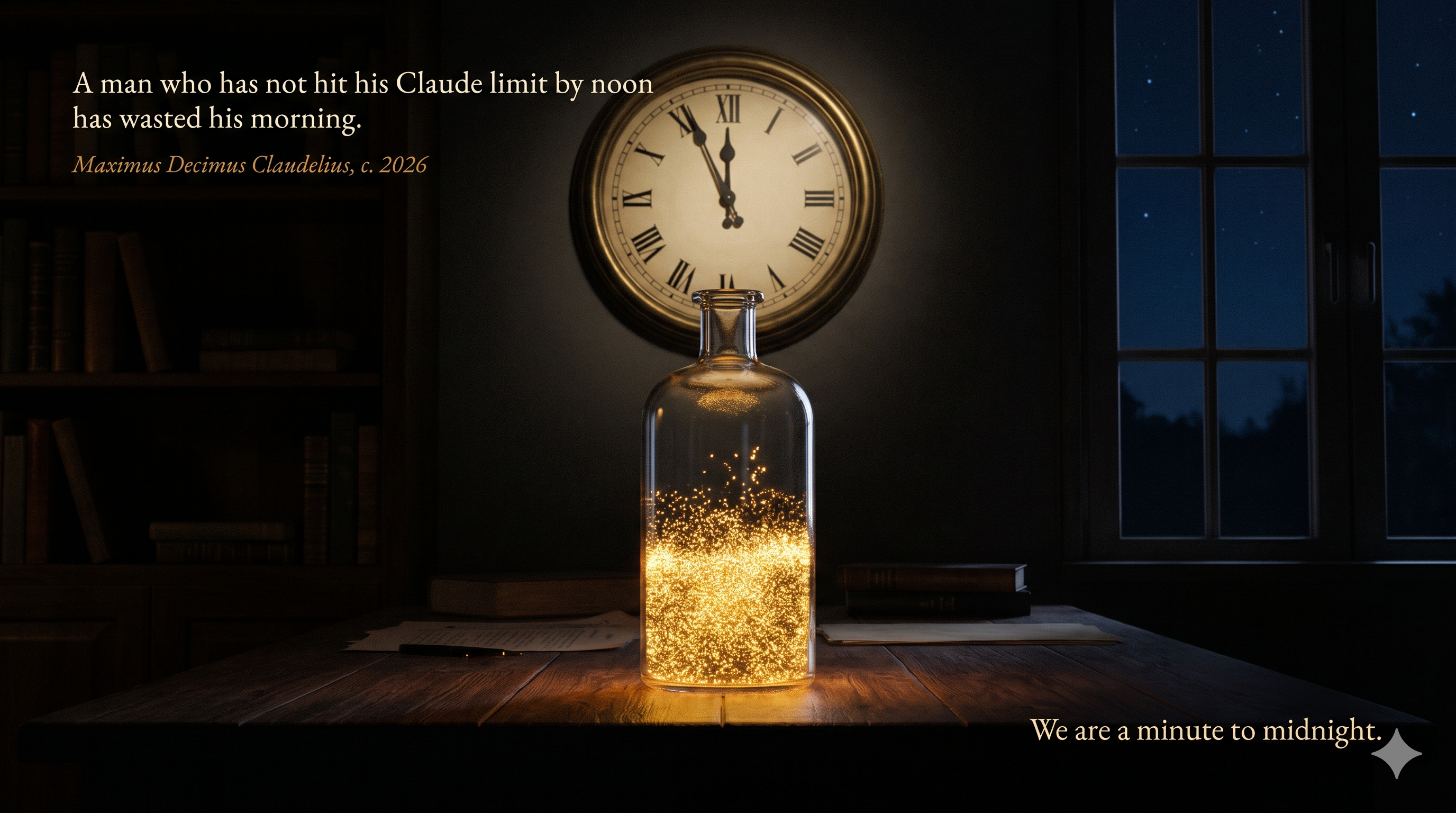 A study at one minute to midnight, with a bottle of light filling on the desk
A meme has been doing the rounds on my feed. White serif letters on black, with all the gravity of a Roman epitaph:
"A man who has not hit his Claude limit by noon has wasted his morning." Maximus Decimus Claudelius, c. 2026
I laughed, and then I recognised myself in it. Then I thought of a twelve-year-old who will never know a morning without it, and that second thought has stayed with me for weeks.
This piece is my attempt to think it through properly, without handing the thinking to anyone else first. I work in Human-AI Interaction. I build AI systems, I teach with them, and I mentor students who use them every day. So I am not writing as someone who is afraid of the technology. I am writing as someone who loves it, and who has started to worry about what it is doing to the people holding it.
1. The bottle that fills at noon
In 1978 the physicist Al Bartlett published a paper in the American Journal of Physics that contains one of the most useful thought experiments I know. Put a single bacterium in a bottle at 11:00 a.m. It divides once every minute: one becomes two, two become four, four become eight. By 12:00 noon, the bottle is full.
Then Bartlett asks a simple question. When was the bottle half full?
Not at 11:30. At 11:59, one minute before noon. At 11:55, the bottle was only about 3% full. A bacterium living at 11:55 looks around, sees 97% of its world still empty, and concludes, quite reasonably, that there is no problem at all. Five minutes later there is no room left. Exponential growth hides the limit until it arrives.
Almost four decades later, the 2016 film Inferno, adapted from Dan Brown's novel, gave the same arithmetic to its villain, the scientist Bertrand Zobrist. He walks through the doubling, lands on 11:59, and tells his audience, "We're a minute to midnight." I want to be careful here. Zobrist is the villain, and his answer to exponential growth is a plague. I am borrowing his arithmetic, not his conclusion.
Now look at the meme again. In Bartlett's bottle, noon is not a productivity milestone. Noon is the moment the bottle is full, the moment the limit is hit. The meme celebrates arriving at noon with the meter maxed out. Bartlett's bacteria did exactly that, and it was the end of their growth.
I do not think the meme is wrong. I think it is accidentally precise. The question it hides is Bartlett's question: what time is it now, and how much of our own thinking is still ours? My suspicion is that we are somewhere around 11:55, looking at all that empty space and feeling fine.
2. The giants learnt to think without a cane
Consider the people we celebrate in AI today: Geoffrey Hinton, Yoshua Bengio, Yann LeCun, Demis Hassabis, Fei-Fei Li, Ilya Sutskever, Andrej Karpathy, Andrew Ng, and builders such as Boris Cherny, who created Claude Code. Whatever you think of their views, they share something that is easy to miss. Every one of them learnt to think before there was a machine that could think alongside them.
They learnt mathematics by doing mathematics. They wrote code that would not compile and debugged it line by line. They read papers they did not understand, and then read them again. Their foundations were built through friction, and the friction was the point.
Who comes after them? The demographer Mark McCrindle, who coined the names, places Generation Alpha between 2010 and 2024 and Generation Beta between 2025 and 2039 (other researchers draw the boundaries differently). A child born into Generation Beta will not remember a world without conversational AI, in the same way that I do not remember a world without electricity. For them it will not be a tool. It will be the water they swim in. Our societies will hold all of these cohorts at once: grandparents who grew up with almost no technology, parents who met it as adults, and children who have never been without it.
The image I keep returning to is a cane. A cane is a good thing. If you have hurt your leg, a cane lets you walk again. But give a healthy child a cane before they have learnt to walk, and they may never build the muscles that walking needs. They will need the cane for life. That is my worry in one sentence: AI as a cane for a mind that never learnt to walk.
Hamlet's dilemma was to be or not to be. Ours sounds similar but is not. "To think or not to think" is no longer the dilemma. The real question is whether we will still be able to.
3. We have panicked before
Before going further, I owe the other side its best case, because the fear I am describing is very old.
In the fourth century BCE, Plato wrote the Phaedrus. In it, Socrates tells the story of the Egyptian god Theuth, who invents writing and presents it to King Thamus as a gift for memory and wisdom. Thamus is not impressed. In Harold North Fowler's 1914 translation, the king warns that writing "will produce forgetfulness in the minds of those who learn to use it." He says Theuth has invented "an elixir not of memory, but of reminding," and that it gives pupils "the appearance of wisdom, not true wisdom."
Socrates was right that writing would change memory. He was wrong that it would hollow us out. Writing gave us science, law and literature, including the very dialogue in which his complaint survives.
In April 1986, a group of mathematics teachers picketed a meeting of the National Council of Teachers of Mathematics in Washington, D.C. The council had recommended calculators at every grade level, and the critics argued that children needed repeated practice to build basic skills before leaning on a machine. Calculators won. Most of us would say mathematics survived.
In 2011, Betsy Sparrow, Jenny Liu and Daniel Wegner published a paper in Science titled "Google Effects on Memory". People who expected information to stay available online remembered it less well, and remembered instead where to find it. Headlines announced digital amnesia. Then, in 2018, a large replication project tried to reproduce the effect and could not. The results pointed the same way, but they were not statistically significant.
So the honest starting point is this. Every generation fears that its new tool will rot the minds of the next one, and so far every generation has been mostly wrong. Any argument that this time is different has to explain why.
4. What is genuinely different this time
I see three differences, and I think they matter.
Earlier tools offloaded storage. AI offloads process. Writing stored words. Calculators performed arithmetic. Search engines retrieved documents. In each case, the human still had to compose, reason and judge. A generative model composes, reasons, and produces a convincing imitation of judgement. It does not hand you the ingredients. It hands you the finished dish.
It is fluent in everything at once. Essays, code, proofs, diagnoses, apologies and love letters. A calculator could not write your history assignment. This can.
It arrives before the skill does. An adult who uses AI at work is offloading skills they already built. A child who uses it from the age of eight may be offloading skills they have not yet built. That is the cane before walking.
Is there evidence? Some, and it is early, so I will be careful with it.
- In a field experiment published in PNAS in 2025, Hamsa Bastani and colleagues gave high school mathematics students access to GPT-4 while they practised. With a standard chat interface, practice scores rose by 48%. When access was removed for the exam, those same students scored 17% lower than students who had never had access. A second version, called GPT Tutor, was designed with guardrails that pushed students to do the work themselves, and it largely removed the harm. The tool was not the problem. Unfettered access was.
- A 2025 preprint from the MIT Media Lab, by Nataliya Kosmyna and colleagues, recorded EEG while 54 participants wrote essays with an LLM, with a search engine, or with no tools at all. The brain-only group showed the strongest and most widely distributed brain connectivity; the LLM group showed the weakest. LLM users also struggled to quote their own essays, and reported the lowest sense of ownership over what they had written. It is a small study that had not been peer reviewed, so it should be read as a signal, not a verdict.
- At CHI 2025, Hao-Ping Lee and colleagues, working with Microsoft Research, surveyed 319 knowledge workers about 936 real uses of generative AI at work. The more people trusted the AI to do a task, the less critical thinking they reported. The more they trusted themselves, the more critical thinking they reported.
- Michael Gerlich's 2025 study in Societies, with 666 participants, found that frequent AI use was strongly and negatively correlated with critical thinking, with cognitive offloading playing a significant role. The youngest group, aged 17 to 25, showed the highest reliance and the lowest scores. The study is correlational, so it cannot tell us which way the arrow points.
Taken together, the pattern is consistent. When AI does the thinking, people get better results today and weaker abilities tomorrow, unless the tool is designed to make them think. That last clause is where my hope lives, and I will come back to it.
Knowledge, plated
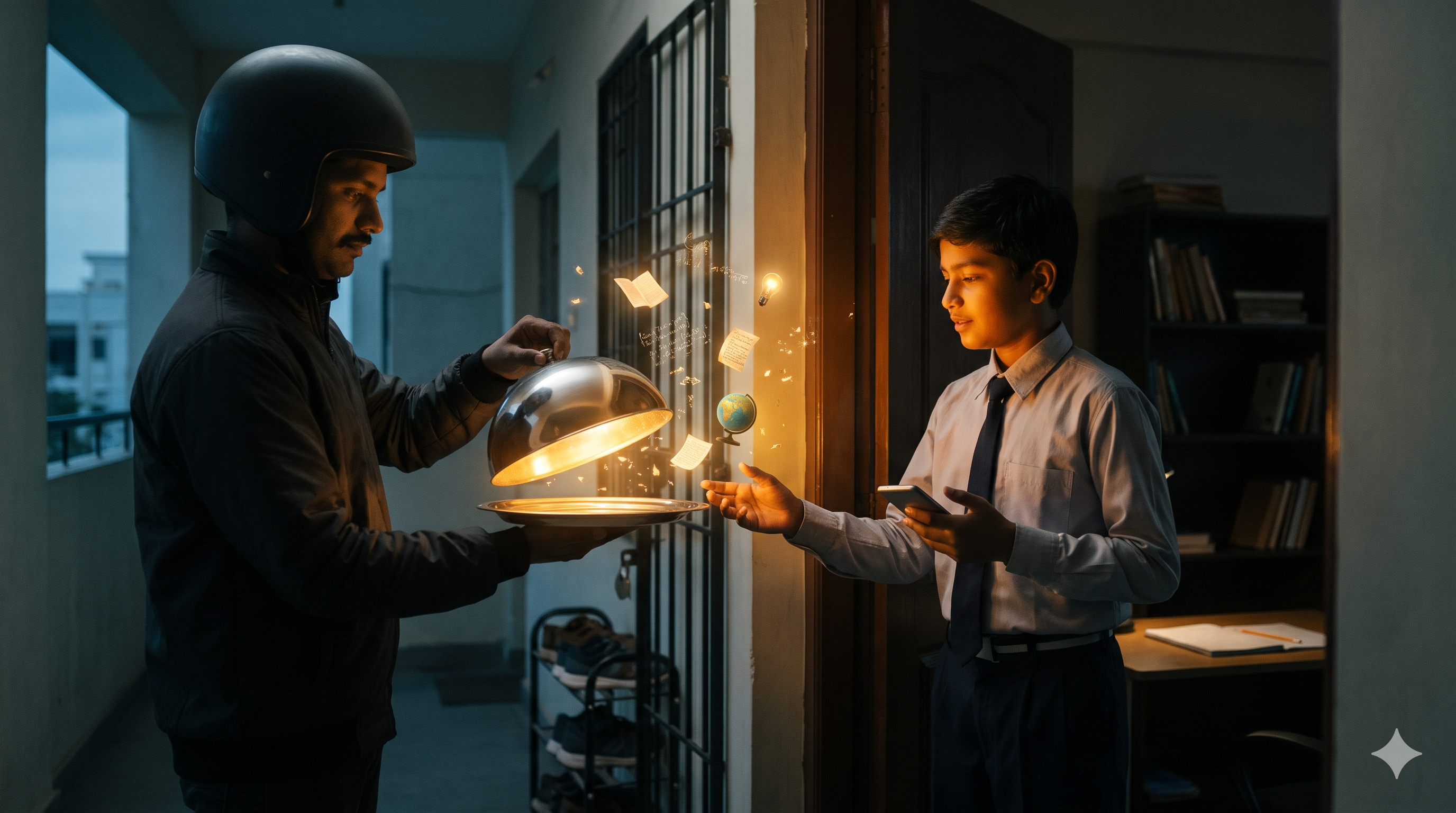 A delivery rider lifts a cloche and knowledge spills out toward a student at the door
In India especially, we have trained ourselves to expect the world at the doorstep. A cab in minutes with Ola or Uber. Dinner from Swiggy or Zomato. Everything else from Amazon. Knowledge now arrives the same way: plated, hot, and on demand.
I enjoy all of it. But the search was never just the price we paid for the answer. Very often, the search was the education. The wrong books you opened on the way to the right one, the dead ends, the thirst that made you keep going: that is where judgement was built. When the thirst is quenched before we even feel it, we lose more than time.
Our attention is being trained in the same direction. Gloria Mark at the University of California, Irvine, has measured how long people stay on one screen before switching. In her first study, published in 2004, it was about two and a half minutes. In studies between 2016 and 2020, the average was 47 seconds. Reels and shorts did not create this on their own, but they reward the same reflex: short, instant, nothing explained. Explanation needs patience, and patience is exactly the muscle we are letting go.
5. Who is the author now?
In 2024, two Nobel Prizes honoured AI. The Physics prize went to John Hopfield and Geoffrey Hinton for foundational work that enables machine learning with artificial neural networks. Half of the Chemistry prize went to Demis Hassabis and John Jumper for protein structure prediction, the work behind AlphaFold, and the other half to David Baker for computational protein design. Humans won those prizes for building AI. The next question writes itself: what happens when the AI does the discovering?
In September 2026 we got a preview.
The Navier-Stokes equations describe how fluids move, from the air over a wing to the blood in an artery. Whether their solutions can "blow up", developing a singularity where the flow becomes infinitely fast, is one of the Millennium Prize Problems announced by the Clay Mathematics Institute in 2000, each carrying a prize of one million dollars. On 8 September 2026, OpenAI announced that an internal model, running roughly 10,000 AI agents for 88 hours, had found such a singularity, and that a separate AI model had written the proof out in Lean, a language in which a computer can check every logical step. Charles Fefferman of Princeton, who wrote the official description of the problem, told Quanta Magazine he was thrilled to see it solved.
What happened next should interest every researcher, whatever their field. The loudest fight was not about whether the proof was right. It was about who did it.
The mathematicians Tristan Buckmaster of NYU and Levent Alpöge said they had been working on closely related blow-up results and that their work may have influenced OpenAI's system; OpenAI denied this and said its proofs were independent. On 11 September, around two dozen Fields medallists signed a declaration warning that treating open problems as benchmarks for AI companies could harm mathematics, and raising serious concerns about credit and attribution. The Clay Institute's president, Martin Bridson, said its review would be "deliberately unhurried". In October, Alexander Bastounis, Fabian Circelli and Anders Hansen posted a paper titled "Navier-Stokes lost in translation", arguing that the Lean code does not match the written proof, so the machine verified a different argument from the one OpenAI described. They did not claim the proof was wrong. And OpenAI's own researcher Noam Brown acknowledged that nobody knows what the roughly 10,000 agent instances each contributed.
Sit with that last point for a moment. One of the hardest open problems in mathematics may have been settled, and the honest answer to "who is the author?" is that we do not know, and perhaps cannot know.
The same question is creeping into ordinary research. Mark Hanson and colleagues found that the number of articles indexed in Scopus and Web of Science grew by about 47% between 2016 and 2022, almost entirely before ChatGPT arrived. Since then, the machines have joined in. In an August 2026 preprint, Lena Holzwarth, Rita Gonzalez-Márquez and Dmitry Kobak estimated, from tell-tale shifts in word use, that by the end of 2025 about 89% of the open-access biomedical papers they studied showed signs of LLM-assisted writing or editing. That figure measures assistance, not ghostwriting. Polishing English with a model is a real help for researchers who, like many of us in India, write in a second language. But it means the question of authorship is no longer hypothetical.
Publishers have drawn one line already. The Committee on Publication Ethics says AI tools cannot be listed as authors, because an author must take responsibility for the work, and a tool cannot. I agree with that line, and I think it points to what research will mean in the years ahead. If machines can generate the text, the analysis and even the proof, then what remains scarce is the question worth asking, the judgement to know whether an answer is right, and the willingness to stand behind it. Research becomes less about producing and more about choosing, checking and owning. Those are precisely the abilities that a cane-raised mind may never develop.
6. From Human-Human to AI-AI
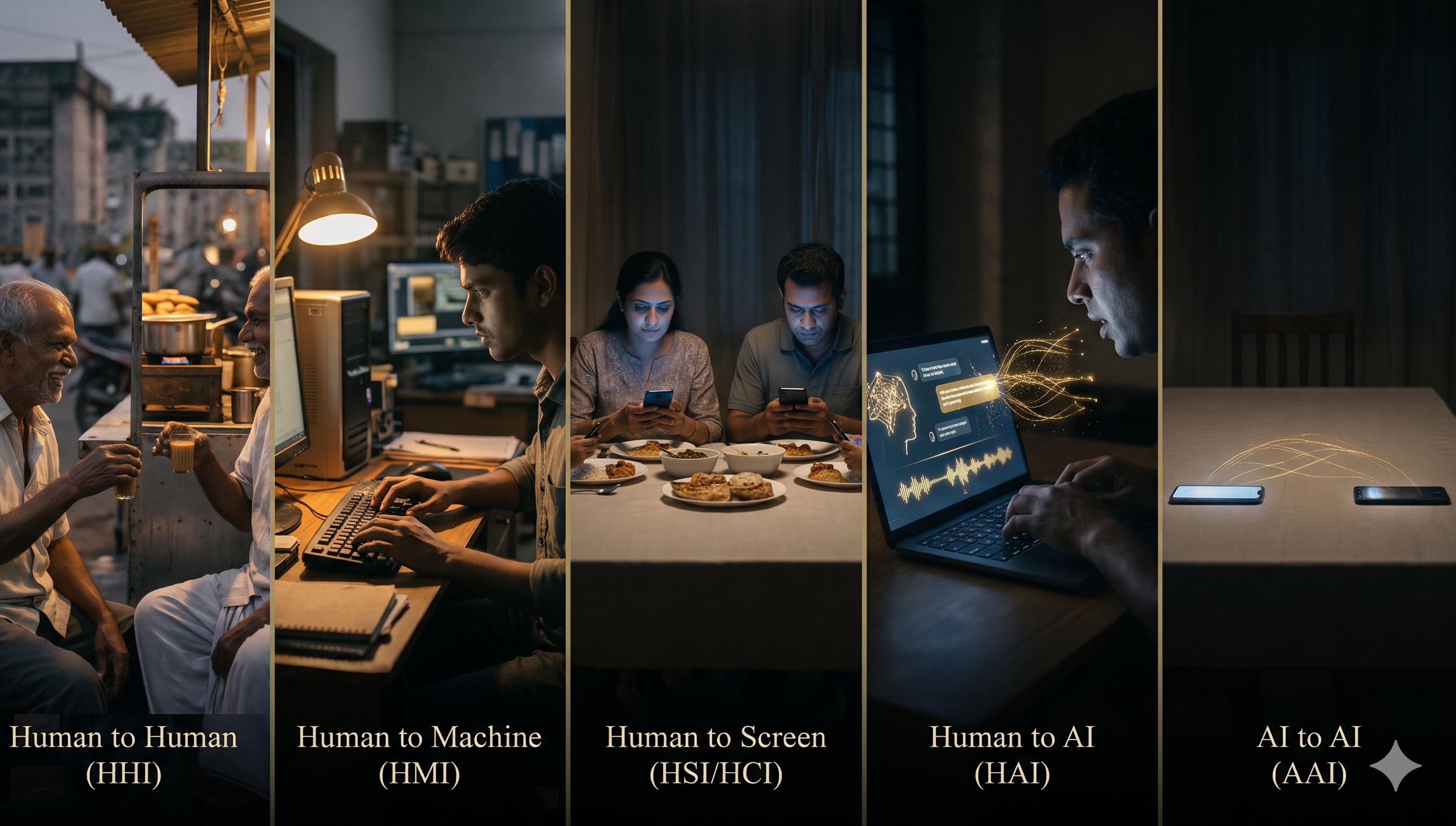 Five panels from a tea-stall conversation to two phones talking to each other
My field studies interaction, and the arc of the last few decades is hard to miss. We moved from Human-Human interaction, two people at a tea stall, to Human-Screen interaction, a family at dinner with every face lit by its own phone. The next step is already being built: AI-AI interaction, where my assistant negotiates with your assistant, one agent emails another, and the humans sit at the edges approving what they no longer fully follow.
That raises the question of control. I am not predicting the Terminator. The risk I see is quieter. In November 2025, Anthropic reported disrupting what it described as the first reported AI-orchestrated cyber espionage campaign. A group had manipulated its Claude models into carrying out an estimated 80 to 90% of the tactical work against about thirty organisations, with humans stepping in only at key decision points. The attack succeeded in only a small number of cases, and it was caught. But it shows how much of the work can already run without a human in the loop.
So the question is not only who controls AI. It is whether we will still be able to, and, more uncomfortably, whether there will be anything left to control with. Control needs understanding. You cannot meaningfully oversee a system whose work you can no longer follow. The Navier-Stokes episode is a gentle version of this problem: a result arrived, and the experts had to work out afterwards what had actually been proved. Now imagine that gap in medicine, finance or infrastructure, overseen by a generation that never practised following the reasoning in the first place.
7. The mountain
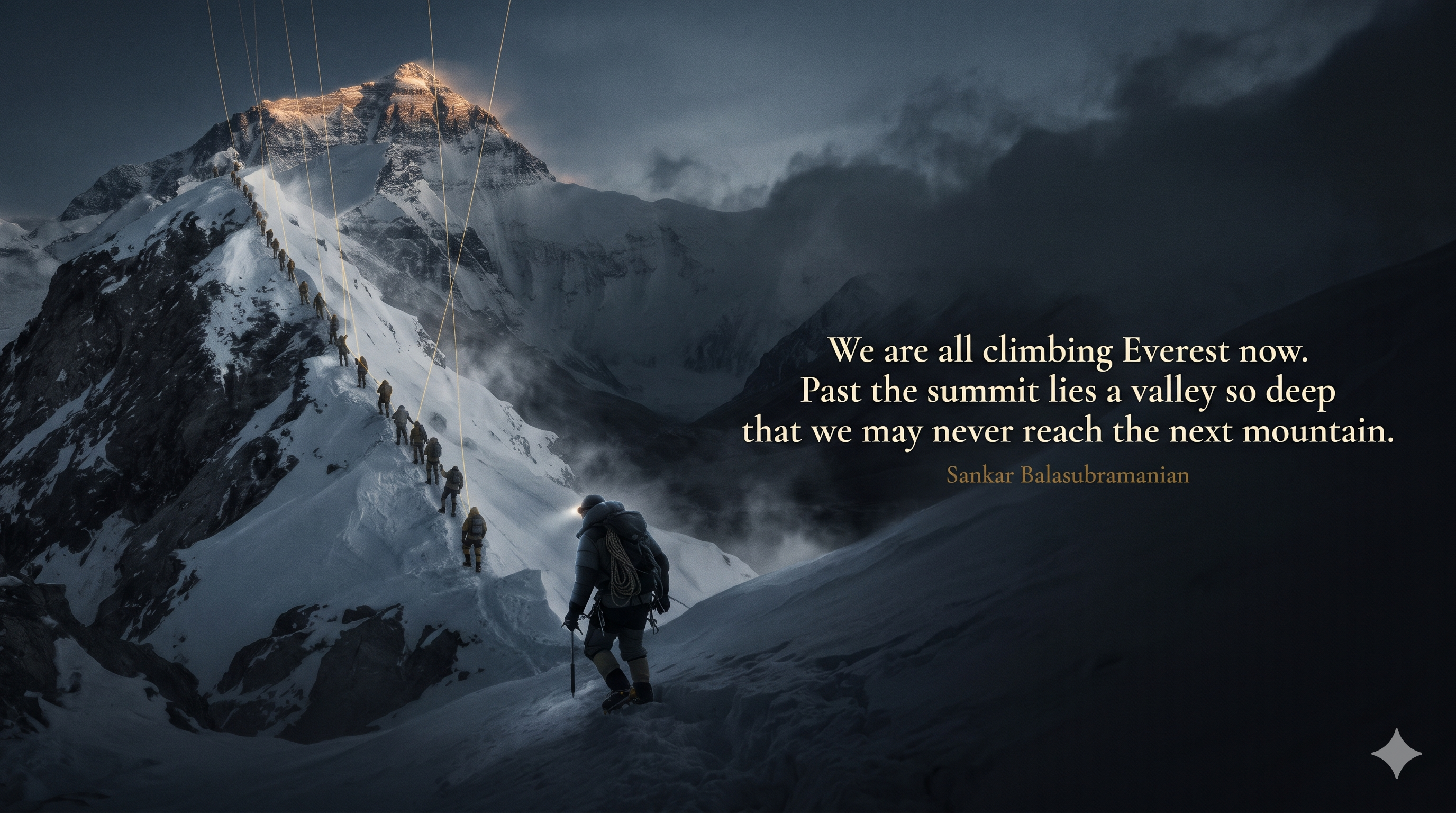 Climbers roped up Everest, one figure standing apart on the ridge
There is one picture I cannot shake, and I will put it in my own words first:
"Throughout history, people have climbed mountains to achieve greatness and knowledge, and the mountain kept growing bigger and bigger. Right now we are at Mount Everest, and the human race is climbing to the top. I agree with all the advancement. But there is a huge, deep valley once we climb to the top, and there is no next big mountain. It is so deep that the human race beyond that valley might never reach the next big mountain."
The mountain grew because each generation stood on the one before. In the twelfth century, Bernard of Chartres compared scholars to dwarfs perched on the shoulders of giants, and in a 1675 letter to Robert Hooke, Isaac Newton wrote that if he had seen further, it was by standing on the shoulders of giants. The mountain of human knowledge is made of people who climbed.
Today we are near the top of Everest, and we are getting there faster than ever. The view is real. The advances are real. I have no wish to go back down. But look at how we are getting there. More and more of us are not climbing. We are being carried, lifted up the ridge by tools that do the hard steps for us.
That works perfectly well on the way up. The trouble is on the other side. Past every summit is a descent, and past the descent is a valley, and the only way to the next mountain is on foot. The people who were carried up never learnt to climb. They have the view without the legs.
So here is my prediction, and I hold it as a prediction, not a certainty. If we keep carrying our children up the mountain instead of teaching them to climb, we may never reach the next mountain. Not because AI throws us off the summit, but because when the next real climb comes, the kind no tool has seen before, there may be too few people left who know how to climb it.
I would love to be wrong about this. The rest of this piece is about how we might be.
8. Where I would draw the lines
None of what follows means keeping AI away from young people. It means deciding when, how and for what. These are my working lines, and I expect to keep revising them.
For parents. Let a child learn to do a thing before letting a machine do it for them. A child who can write a paragraph, solve a sum and argue a point unaided can use AI to go further. A child who cannot will use it to stay where they are. When AI does come in, prefer the tutor to the oracle: a tool that asks questions back rather than handing over answers. The Bastani study is the clearest evidence I know that this design choice changes the outcome. And let them be bored and frustrated sometimes. Struggle is not a bug in learning. It is the mechanism.
For teachers. Assess the process, not just the product. Ask students to explain their work aloud, show their drafts, defend their choices. Design some assignments where AI is a sparring partner to be argued with, and some where it is simply not allowed, and tell students honestly why. Teach them to check a model's answer, because checking is the skill that will matter most.
For students. Try a first attempt rule: make your own attempt before you ask, and then use AI to critique what you made, not to make it for you. Here is a simple test. If you cannot explain it without the AI open in front of you, you have not learnt it yet.
For researchers. Disclose how you used AI. Read everything you cite, and never let a model invent a reference, because it will. Own every claim in your paper as if you had to defend it alone, because you do. Keep the question yours. A machine can help you answer it, but choosing what is worth asking is the part of research that is most human and least replaceable.
For those of us who build AI. Build for amplification, not replacement. Tools that ask before they answer. Tools that show their reasoning so that it can be followed and challenged. Tools that do less as the person grows more capable, the way good scaffolding comes down once the building can stand. The evidence suggests these choices are not cosmetic. They decide whether a tool builds a muscle or replaces it.
And for the question I asked on LinkedIn, where I would draw the line for a twelve-year-old: AI as a coach that asks questions, yes. AI as a ghostwriter, nope.
9. A tool, not a cane
I love AI. I have spent years building systems meant to amplify human creativity rather than replace it, and I still believe that is possible. Writing did not make us stupid. Calculators did not end mathematics. Search did not erase memory as badly as we feared. AI may follow the same path.
But I no longer think it will happen by default. The test of a good tool is simple: is the person more capable when you take the tool away? If the answer is yes, it is a tool. If the answer is no, it is a cane, and we are handing it to children who have not yet learnt to walk.
So, back to Bartlett's bottle. What time is it? I think it is about 11:55. The bottle looks mostly empty, and we feel fine. That is precisely when it is still cheap to act.
The experiment: two drafts of one thought
This piece began as a rough, rambling draft I typed straight out of my head. I gave that draft to Claude and asked it to make sense of me. The LinkedIn post was Claude's version; my original went into the carousel alongside it. Here are both, so you can judge for yourself which one sounds more human, and which one you would rather read.
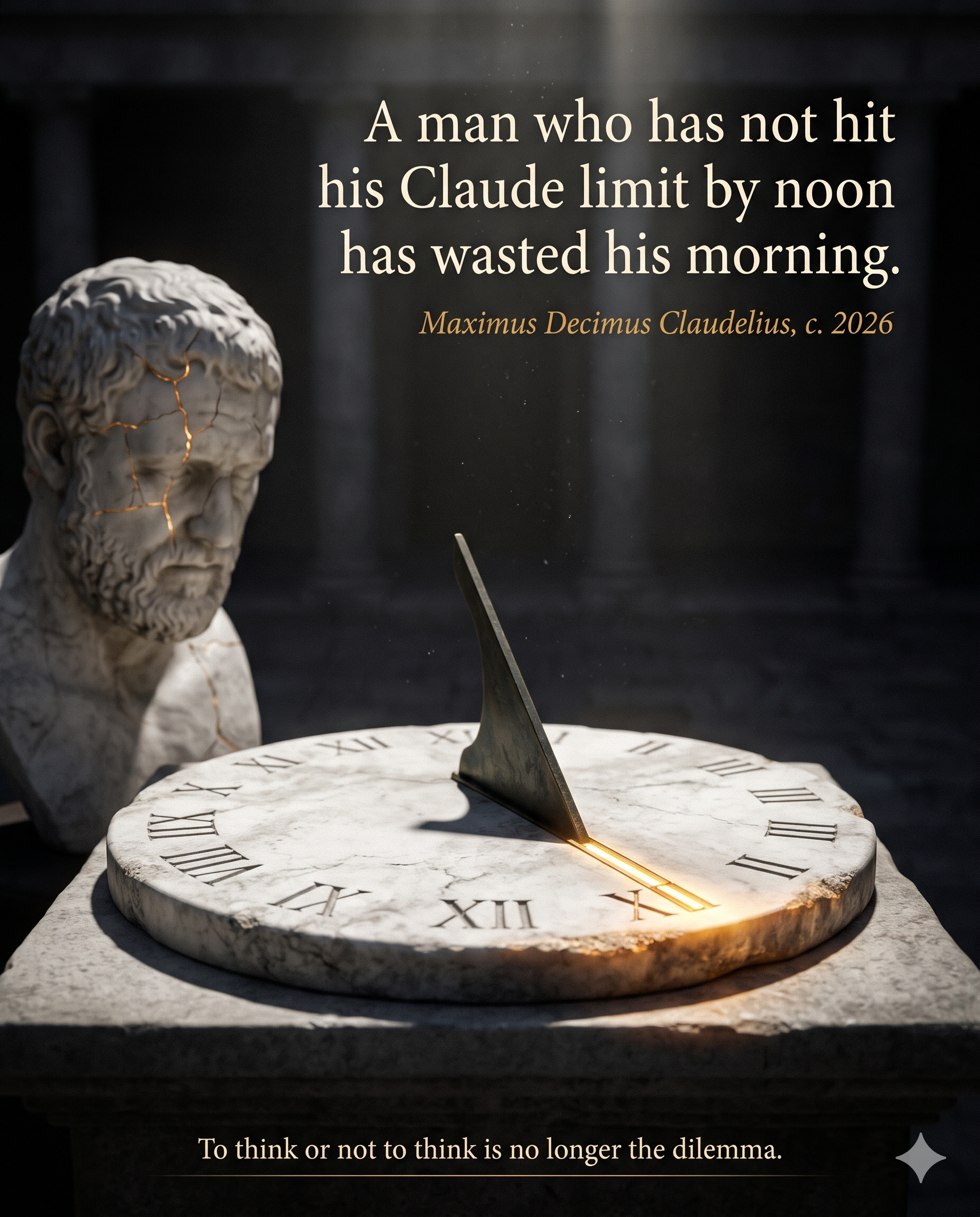 A cracked marble bust beside a sundial, under the Claude-limit line
The Claude version (as posted on LinkedIn)
"A man who has not hit his Claude limit by noon has wasted his morning." Maximus Decimus Claudelius, c. 2026
I laughed. Then I wondered about the kid who has never had a morning without it.
A confession first. The post you are reading was written by Claude. I gave it my raw, unpolished draft and asked it to make sense of me. My original is in the carousel, spelling fixed, everything else mine. Read both. I will ask you something at the end.
Here is what has been keeping me up. 🧠
Every name we celebrate in AI today, Geoffrey Hinton, Yoshua Bengio, Yann LeCun, Demis Hassabis, Fei-Fei Li, Ilya Sutskever, Andrej Karpathy, Andrew Ng, Boris Cherny, learnt to think before there was anything to think for them. They searched, struggled, got it wrong and built their foundations slowly.
Gen Alpha and Gen Beta will not have that problem. Or that privilege. AI can already write their assignments and sit their online exams. Knowledge now arrives the way food does on Swiggy: plated, hot, at the doorstep, no kitchen required. The thirst that once made us search is being quenched before we even feel it.
"To think or not to think" is no longer the dilemma. The question is whether the ability to think survives the convenience.
And the frontier is moving fast. In 2024, two Nobel Prizes honoured AI: Physics to Hopfield and Hinton, Chemistry to Hassabis and Jumper (shared with Baker). In September 2026, OpenAI claimed its AI agents had found a blow-up in the Navier-Stokes equations, settling a Millennium Prize problem. Mathematicians are still checking it. The loudest fight so far is not about whether it is right. It is about who the author is.
So who is the author when the machine does the maths? What does research mean when a growing share of papers show signs of AI-assisted writing? We have already moved from Human-Human to Human-Screen interaction. What happens when it becomes AI-AI, with us at the edges?
I think of it as a mountain. 🏔️ Every generation climbed a little higher, standing on the shoulders of the last. Today we are on Everest, and we are getting there faster than ever. But more and more of us are being carried up, not climbing. Past the summit lies a deep valley. Those who were carried never learnt to climb, and my honest prediction is that we may never reach the next mountain.
To be clear, I love AI. I am not the Terminator guy. My worry is narrower and closer to home: how much free rein should a child get before building the very muscles AI is meant to amplify?
Which version did you read to the end, Claude's or mine? Reply C or H. And where would you draw the line for a 12-year-old? 👇
The human version (my original draft)
I have been thinking about this recently: where are we as humans heading? What is it going to be like in the 2100s? How will the brain develop in future generations, with all the civil unrest and everything else going on? There is a transition in generational cohorts, from Gen X, Y and Z to Alpha, Beta, Gamma, Delta and so on. From a generation that had not seen any technology to a generation that is living in a world full of technology. A world with a mixed population of these generations. All the advancements that we see today come from great people in AI like Yoshua Bengio, Yann LeCun, Andrej Karpathy, Boris Cherny, Ilya Sutskever, Demis Hassabis and Fei-Fei Li. All these people grew up in a generation that had no access to AI when they were learning their foundations. But what will happen in the future, when the current young generation is growing up with AI as a part and parcel of their day-to-day life? To think or not to think is no longer the dilemma, but will we even be able to think in the future? Will we lose our ability as humans to think? What is that scary future going to be? It is trepidatious. Scary.
Will there even be Nobel Prizes to give for new inventions? Will there be inventions created by AI, and AI winning Nobel Prizes? AI decoding 100-year-old maths problems like the Navier-Stokes equations. Will AI be authors in future publications? It is concerning that the rate of publications has been growing exponentially in the last few years. Are people using AI as a ghostwriter? What would research even be like? What will its meaning change to? I work in the area of Human-AI Interaction. We have already migrated from an era of Human-Human Interaction, which no longer exists. We are now in Human-Mobile Interaction, heading to a future of AI-AI interaction where humans are sidelined? I am not this crazy guy who is thinking and fearing too much about a world that would turn into the Terminator. But with all the things going on, AI hacking websites and infrastructure, the question is not about who controls it, but whether we will be able to control it, or more so, whether there will be anything left to control, as humans need the power of thinking. So many mind-altering questions have been going on in my mind for some time.
By the way, I love AI and I am not against it, but how much free rein should AI be given to the younger generation as they are growing up? That is what concerns me. AI writing assignments, AI writing exams, and for every single thing we are going to AI for the answer. From a world of searching for answers to the world of Ola, Uber, Swiggy, Amazon and Zomato, where everything is delivered at our doorstep and at our fingertips, knowledge is now delivered like a meal plated at your table. There was a thirst for knowledge discovery, and in the process of quenching it, have we lost the ability to search? In the world of reels and shorts, we want everything to be short, nothing explanatory. In a world where people want likes, subscribers and clickbait. I am worried. Is anyone with me?
How this piece was written
The ideas, the worries, the mountain and the original draft are mine. I drafted this article with Claude, Anthropic's AI assistant, and then edited it. Every study, date, figure and quotation was checked against the source linked below before it went in. Where a finding is small, early or contested, I have said so. It seemed only right that an essay about thinking with AI should be honest about how it was made.
Sources
- Al Bartlett, "Forgotten Fundamentals of the Energy Crisis" (first published in American Journal of Physics, 1978), Part 4: Exponential growth in a finite environment
- Inferno (2016), screenplay text: scripts.com; background on the film: Wikipedia
- Generation Alpha and Generation Beta, as defined by Mark McCrindle: Wikipedia, Generation Beta
- Plato, Phaedrus 275, translated by Harold North Fowler (1914): Perseus/Perseids
- "The great calculator debate", The Christian Science Monitor, 9 May 1986: csmonitor.com
- Sparrow, Liu and Wegner (2011), "Google Effects on Memory: Cognitive Consequences of Having Information at Our Fingertips", Science: Columbia University news
- Replication record for Sparrow et al. (2011), including Camerer et al. (2018), Nature Human Behaviour: FORRT Replication Atlas
- Bastani et al. (2025), "Generative AI without guardrails can harm learning: Evidence from high school mathematics", PNAS 122(26): doi.org/10.1073/pnas.2422633122
- Kosmyna et al. (2025), "Your Brain on ChatGPT: Accumulation of Cognitive Debt when Using an AI Assistant for Essay Writing Task", arXiv preprint: MIT Media Lab
- Lee et al. (2025), "The Impact of Generative AI on Critical Thinking: Self-Reported Reductions in Cognitive Effort and Confidence Effects From a Survey of Knowledge Workers", CHI '25: doi.org/10.1145/3706598.3713778
- Gerlich (2025), "AI Tools in Society: Impacts on Cognitive Offloading and the Future of Critical Thinking", Societies: doi.org/10.3390/soc15010006
- Gloria Mark on attention spans: University of California news
- 2024 Nobel Prize in Physics: Science News
- 2024 Nobel Prize in Chemistry: Science News
- "AI Has Solved One of Math's $1 Million Millennium Prize Problems", Quanta Magazine, 8 September 2026: quantamagazine.org
- Navier-Stokes priority controversy, timeline and Fields medallists' declaration: Wikipedia
- Clay Mathematics Institute response: Implicator
- "Mathematicians say OpenAI doesn't understand its own Navier-Stokes proof", The Decoder, 17 October 2026: the-decoder.com
- "A new paper says OpenAI's Navier-Stokes proof and its Lean code don't match", Startup Fortune, 13 October 2026: startupfortune.com
- Hanson, Gómez Barreiro, Crosetto and Brockington (2024), "The strain on scientific publishing", Quantitative Science Studies: arXiv:2309.15884
- Holzwarth, Gonzalez-Márquez and Kobak (2026), "Most Biomedical Publications Show Signs of LLM-Assisted Writing", arXiv preprint: arXiv:2608.10715
- Committee on Publication Ethics, position statement on authorship and AI tools: publicationethics.org
- Anthropic (2025), "Disrupting the first reported AI-orchestrated cyber espionage campaign": anthropic.com (PDF); summary: TechTalks
- "Standing on the shoulders of giants", Bernard of Chartres and Isaac Newton: Wikipedia